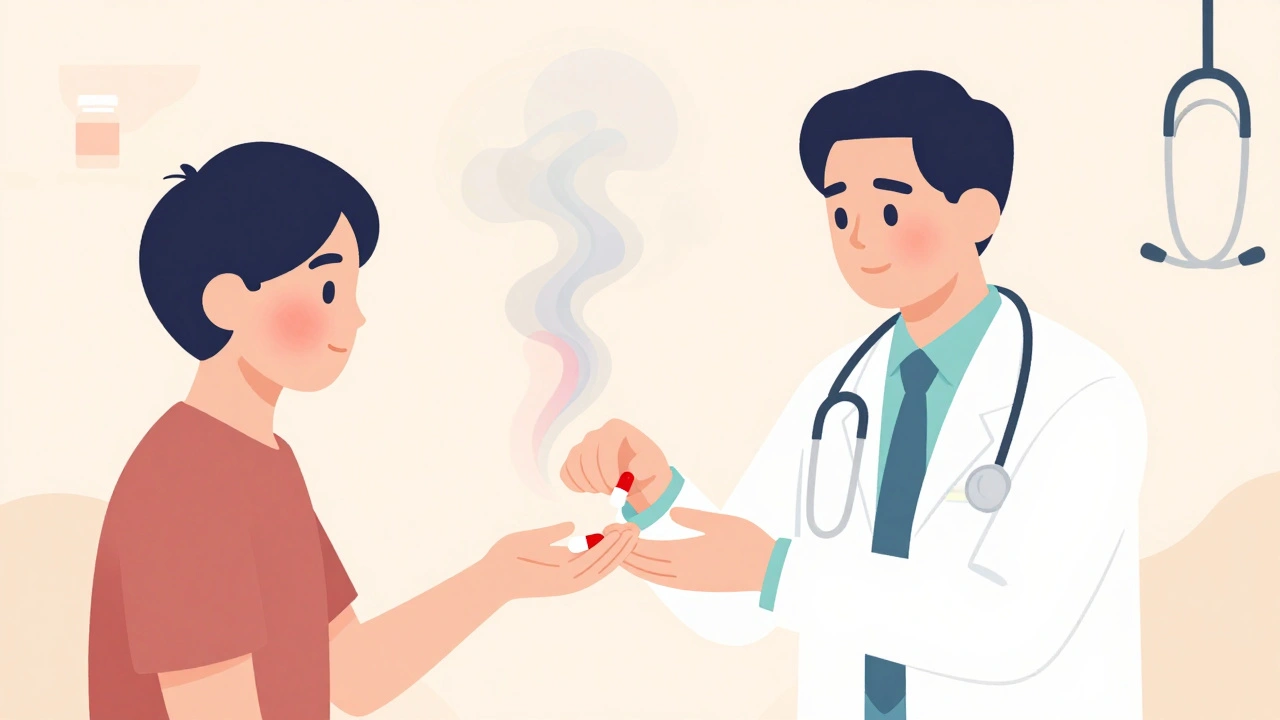
When a patient starts feeling worse after taking a new medication, doctors don’t just assume it’s the drug’s fault. They need proof. That’s where dechallenge and rechallenge come in-two simple but powerful clinical tools used to figure out if a drug is really causing the problem.
What Is Dechallenge?
Dechallenge is the act of stopping a drug to see if symptoms get better. It’s the first step in figuring out if a side effect is actually caused by the medication. If the rash, nausea, dizziness, or liver enzyme spike disappears after the drug is pulled, that’s a positive dechallenge. It doesn’t prove the drug caused it, but it strongly suggests it.Let’s say someone takes metronidazole for a bacterial infection and develops a painful, recurring skin rash. After three days, their doctor tells them to stop the drug. Two weeks later, the rash is gone. That’s a classic positive dechallenge. The timing matters-symptoms should fade within a timeframe that matches how long the drug stays in the body. If the drug has a short half-life, like ibuprofen, improvement should show up in a day or two. For drugs that stick around longer, like fluoxetine, it might take a week or more.
But here’s the catch: if symptoms don’t improve after stopping the drug, that’s a negative dechallenge. It doesn’t always mean the drug is innocent. Sometimes the damage is permanent-like nerve damage from chemotherapy or scarring from a severe skin reaction. Or maybe the patient stopped too early, or other drugs were still in play. That’s why dechallenge alone isn’t enough.
What Is Rechallenge?
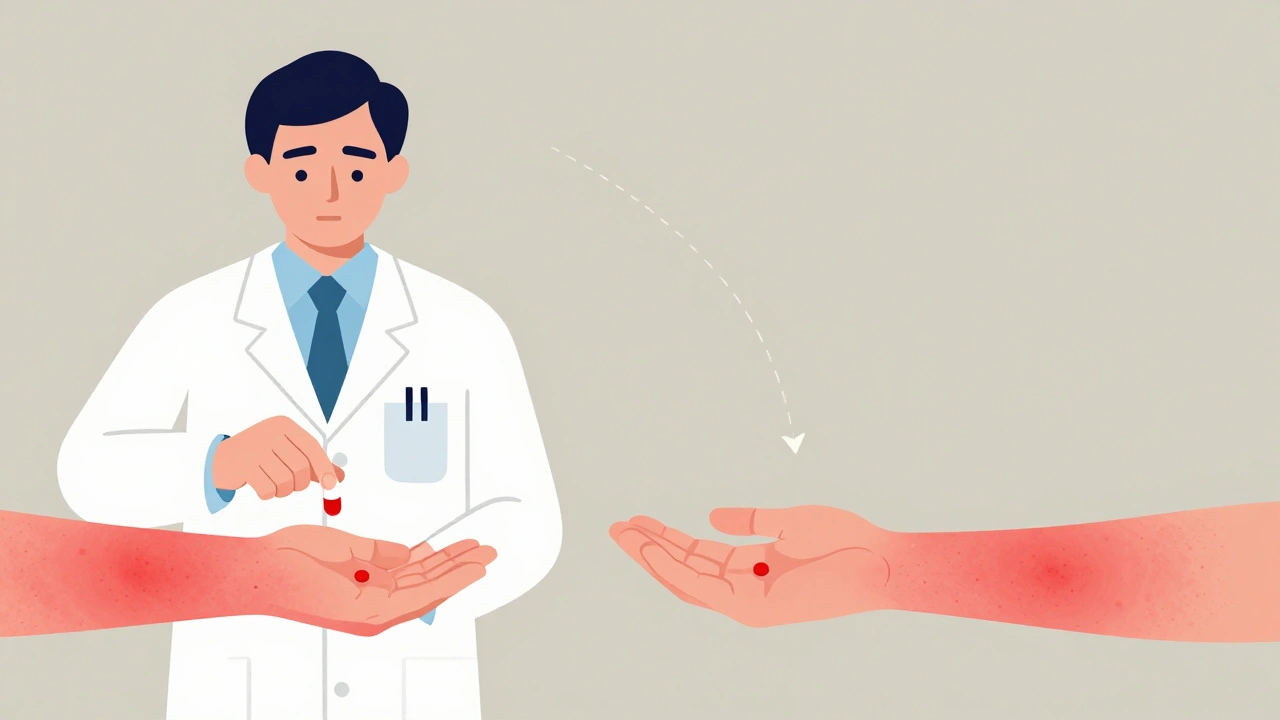
Rechallenge is when you give the drug back-on purpose-to see if the same side effect comes back. If it does, that’s powerful evidence. In fact, under global pharmacovigilance standards, a successful rechallenge bumps the likelihood of drug causality from “probable” to “definite.”The metronidazole case is textbook. After the rash cleared, the patient was given the drug again under close supervision. Within 48 hours, the exact same rash reappeared in the same spot. That’s not coincidence. That’s causation. Rechallenge doesn’t just suggest a link-it confirms it.
But here’s the problem: rechallenge is risky. If the side effect was liver failure, Stevens-Johnson syndrome, or anaphylaxis, giving the drug back could kill someone. That’s why it’s rarely done. In dermatology, where reactions are often visible but not deadly, rechallenge happens in about 15% of suspected cases. In psychiatry or cardiology, where stopping a drug can trigger relapse or heart events, it’s almost never done.
The FDA and European regulators allow rechallenge only under strict conditions: institutional review board approval, full informed consent, emergency protocols on standby, and only for non-life-threatening reactions. In practice, fewer than 0.3% of serious adverse drug reaction reports involve rechallenge.
Why These Tests Matter in Real Life
Imagine a 68-year-old woman on five medications for high blood pressure, diabetes, and arthritis. She develops a sudden, unexplained fever and joint pain. Her doctor suspects a drug reaction. But which one? Stopping all five at once? That’s not helpful-it’s chaos. Dechallenge helps narrow it down.Doctors start by stopping the newest drug first. If symptoms improve, they keep it stopped. If not, they move to the next. This step-by-step process, called sequential dechallenge, is how most drug-causality investigations unfold in clinics. It’s messy, but it works.
Rechallenge, when done safely, turns suspicion into certainty. For a patient who had a mild rash from a new antibiotic, rechallenge might confirm the culprit so they can avoid it for life. For a pharmacist reviewing adverse event reports, a documented rechallenge means the case gets flagged as high-priority for regulatory review.
Pharmaceutical companies rely on this data. When a drug gets approved, it’s not just tested in clinical trials. Post-market safety teams dig through real-world reports. If multiple patients show positive dechallenge and rechallenge outcomes, regulators may add a black box warning or even pull the drug. In 2023, over 82% of major drug manufacturers required dechallenge documentation in their post-marketing safety reports, according to PhRMA.
What Happens When Dechallenge and Rechallenge Aren’t Possible?
Most of the time, they aren’t. Patients stop their meds on their own. They forget to tell their doctor. Or they’re too sick to risk re-exposure. So what do doctors use instead?The Naranjo Scale is a common tool. It’s a questionnaire that scores things like: Did symptoms improve after stopping the drug? Did they return when it was restarted? Was there another cause? It gives you a probability-possible, probable, definite-but it’s still guesswork.
Another method is biological plausibility. Does the drug have a known link to this side effect? For example, statins are linked to muscle pain. That’s plausible. But if a patient gets a headache after taking a statin, that’s not well-supported. Plausibility helps, but it’s not proof.
Then there’s timing. Did the reaction happen within a reasonable window after starting the drug? If a patient takes a new pill and gets dizzy two weeks later, it’s less likely to be the drug. If it’s within 24 hours, that’s a red flag.
These methods are useful, but they’re like detective work without fingerprints. Dechallenge and rechallenge are the fingerprints.
How Technology Is Changing the Game
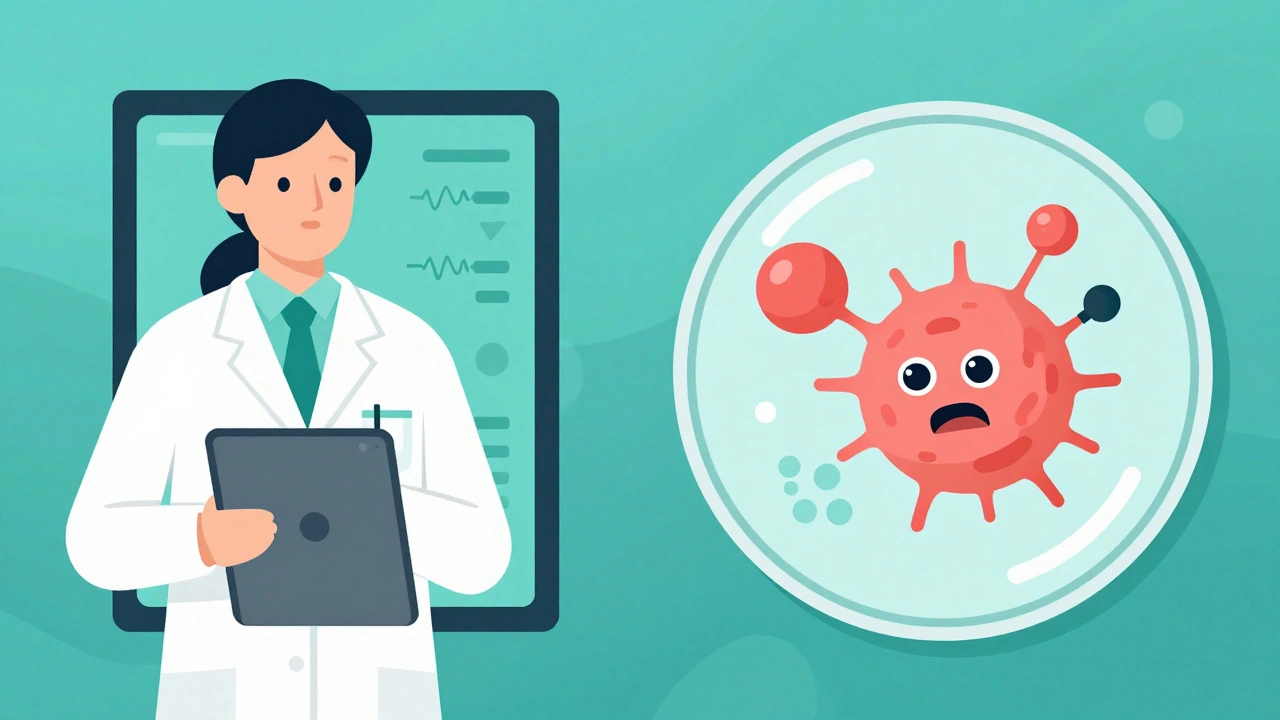
New tools are emerging to make dechallenge safer and more accurate. Wearable sensors can now track heart rate, skin temperature, and even inflammatory markers in real time. In a 2022 study, these devices detected symptom resolution in 78% of cases-compared to just 52% relying on patient self-reports.Lab tests are also helping. Researchers at the NIH developed a blood test that checks how a patient’s immune cells react to a drug in a petri dish. If the cells go into overdrive when exposed to the drug, it’s a sign the patient is likely to react badly. This test is 89% accurate and could replace rechallenge for many patients in the future.
Even AI is getting involved. The WHO is testing a machine learning model that predicts whether a reaction will resolve after stopping a drug, based on thousands of past cases. It’s 76% accurate. Not perfect-but it helps doctors decide whether to stop a drug or wait.
Still, experts agree: no algorithm replaces the real-world observation of a patient getting better after stopping a drug. As Dr. Elena Rodriguez from the WHO put it in 2024, “No algorithm can substitute for the clinical reality of symptom resolution.”
What Patients Should Know
If you think a medication is making you sick, don’t just quit it cold turkey. Talk to your doctor. Stopping some drugs suddenly can be dangerous-like antidepressants or blood pressure meds. Your doctor can help you taper safely and track your symptoms.Keep a simple log: when you started the drug, when symptoms began, what they felt like, and when they improved after stopping. That info is gold for your doctor. It’s the raw data behind dechallenge.
And if your doctor suggests rechallenge? Ask why. Understand the risks. Make sure you’re in a controlled setting. It’s not something you do at home.
The Bigger Picture
Dechallenge and rechallenge aren’t just clinical tricks. They’re the backbone of drug safety worldwide. Every time a drug is pulled from the market or gets a new warning label, it’s often because someone, somewhere, stopped the drug-and got better. Or took it again-and got sick.Regulators in the U.S., Europe, and beyond now require these assessments to be documented in every adverse drug reaction report. The global pharmacovigilance market is worth over $12 billion and growing fast, because companies and governments need to know what’s safe.
For patients, it means better, safer medications. For doctors, it means clearer answers. For science, it means moving from guesswork to proof.
So the next time you hear a doctor say, “Let’s stop this medicine and see what happens,” know this: they’re not just guessing. They’re doing science.
What does a positive dechallenge mean?
A positive dechallenge means that when the suspected drug was stopped, the adverse reaction improved or disappeared. This suggests the drug was likely causing the side effect. For example, if a rash clears up within a week after stopping an antibiotic, that’s a positive dechallenge. It doesn’t prove causation, but it’s strong evidence.
Is rechallenge always safe?
No, rechallenge is not always safe. It can be life-threatening if the original reaction was severe-like liver failure, Stevens-Johnson syndrome, or anaphylaxis. Rechallenge is only done under strict supervision, with ethics board approval, and usually only for mild reactions like minor rashes or nausea. In most cases, doctors avoid it entirely because the risk outweighs the benefit.
Can dechallenge and rechallenge be used for any drug side effect?
They’re most useful for reactions that are reversible and clearly linked in time to drug use. Skin rashes, nausea, dizziness, and mild liver enzyme changes are common candidates. They’re less useful for permanent damage (like hearing loss from certain antibiotics) or for side effects that take months to appear (like some cancers from long-term drug use). Also, if a patient is on multiple drugs, it’s hard to know which one caused the reaction.
Why don’t doctors always do rechallenge?
Because it’s risky. Deliberately giving a drug back that caused a bad reaction could harm or even kill the patient. Ethical guidelines and regulatory rules limit rechallenge to very specific, low-risk cases. In fact, fewer than 0.3% of serious adverse event reports involve rechallenge. Doctors rely on dechallenge, timing, and biological plausibility instead.
How do pharmacovigilance experts use dechallenge and rechallenge data?
Pharmacovigilance teams use this data to determine if a drug should get a stronger warning label, be restricted, or even be pulled from the market. A case with documented positive dechallenge and rechallenge is treated as definitive proof of causality. Regulatory agencies like the FDA and EMA require this information in safety reports. Companies that track this data accurately have fewer legal issues and faster drug approvals.


i just had a rash from amoxicillin and my doc said 'try stopping it' and boom-gone in 3 days. no rechallenge though, i was too scared. like, what if it comes back worse? i still avoid penicillin like it’s radioactive.
Dechallenge? Please. My sister’s doctor gave her a drug she was clearly allergic to, then said 'let’s see what happens'-she ended up in the ER. This isn’t science, it’s Russian roulette with pills.
My mom’s on 7 meds and got dizzy last year. They stopped the newest one-she felt better in 48 hours. No rechallenge, no drama. Just… common sense. Doctors should do this more often instead of just prescribing more pills.
Oh my god, I’m literally shaking reading this. I had a rechallenge. I DID. After the rash cleared, they gave me the drug back. I was 22, naive, and thought 'it’ll be fine.' It wasn’t. The second rash was worse. I had to be hospitalized. Now I have a medical alert bracelet. This isn’t just 'science'-it’s trauma wrapped in a lab coat. I don’t care what the FDA says. Never do it again.
And yes, I know rechallenge is rare. That’s why it’s terrifying. You’re trusting someone with your life based on a 0.3% statistic. What if you’re in that fraction? What if you’re the one who dies because someone thought 'it’s probably fine'?
I’m not mad at the doctor. I’m mad at the system that lets this happen at all. Why isn’t there a blood test for everything? Why do we still gamble with people’s bodies like it’s a carnival game?
I still get panic attacks when I see a prescription bottle. I don’t trust any drug anymore. And honestly? I don’t think I ever will.
rechallenge is a bad idea
you know what’s really scary? the fact that Big Pharma knows exactly how many people will die from rechallenge before they even test it. they don’t care. they just want the patent to last longer. this whole 'dechallenge' thing? it’s a PR stunt. the real data? buried in a spreadsheet somewhere. the FDA? owned by the same people who make the drugs.
they let you think you’re safe. they let you think science is on your side. but the truth? you’re just a data point in a profit spreadsheet. and if you get sick? well, that’s just the cost of doing business.
they’ll never test the real risk. they’ll never release the full data. they’ll just say 'it’s rare' and move on. until it’s your kid. until it’s your mom. until it’s you.
As someone who’s worked in clinical research, I can say this: dechallenge is the most underused tool in primary care. Most GPs don’t have the time or training to do it right. But when they do? It’s life-changing. I’ve seen patients with chronic fatigue finally feel normal after stopping a statin they’d been on for 8 years. No one even thought to check.
Rechallenge? Yeah, it’s risky. But in dermatology clinics, we do it all the time with mild rashes. You get consent, you monitor, you have epinephrine ready. It’s not reckless-it’s responsible. The real problem? Most patients don’t know to ask for it.
Doctors need to stop treating patients like passive recipients. We need to teach people: if you feel weird after a new med, speak up. Ask: 'Could this be the drug?' That’s the first step to real safety.
So basically, doctors are just guessing. They stop a drug, hope the person feels better, and call it 'science.' Meanwhile, the drug company is still selling it to millions who aren’t lucky enough to have a doctor who cares enough to pull the plug.
I’m not saying it’s useless. I’m saying it’s lazy. If we had real biomarkers, we wouldn’t be playing this guessing game. We’d just run a test. But no-better to wait for someone to nearly die before we admit we don’t know what’s going on.
My partner had a reaction to a new blood pressure med. We didn’t know what was happening. I kept a journal-when he took it, when he felt weird, when it faded. When we showed it to the doctor, they were shocked. 'You did all this?' Yeah. Because I didn’t want him to suffer because no one asked.
That journal? It was the difference between 'maybe it’s the drug' and 'yes, it’s definitely the drug.' I’m not a nurse. I’m just someone who loves someone and didn’t want them to be a statistic.
Thank you for writing this. It’s nice to see someone actually explain how important this stuff is. Most people don’t even know these terms exist.
⚠️⚠️⚠️ ATTENTION: THE USE OF RECHALLENGE IN PSYCHIATRIC PATIENTS IS A VIOLATION OF THE HELSINKI DECLARATION AND SHOULD BE CLASSIFIED AS CRIMINAL NEGLIGENCE. ⚠️⚠️⚠️
Let me be crystal clear: if you are a clinician considering rechallenge for a patient with a history of SSRI-induced psychosis, you are not a healer-you are a liability. The fact that this is even a topic of discussion in 2024 is a national disgrace.
AI models? Wearables? Please. These are distractions. The only ethical path is: STOP THE DRUG. NEVER RE-EXPOSE. PERIOD. The cost of one death outweighs the entire pharmacovigilance industry’s budget.
And yes, I’ve reviewed 147 FDA safety reports. 12 of them involved rechallenge. 3 resulted in death. The rest? Just more data for corporate lawyers to bury under 'probable causality.'
Exactly. And yet, they still do it. In the UK, they had a case last year where a woman got rechallenged for a mild rash… and developed toxic epidermal necrolysis. She lost 60% of her skin. Now she’s on lifelong immunosuppressants. And the hospital? They called it 'an unfortunate but acceptable risk.'
Acceptable? No. Criminal.
You people are naive. You think this is about safety? It’s about liability. Doctors avoid rechallenge because they’re scared of lawsuits. Not because they care about you. They’d rather keep you on 5 meds and call it 'multifactorial' than admit they messed up.
And don’t get me started on the Naranjo Scale. It’s a glorified fortune cookie. 'Did symptoms improve after stopping?' Yes. 'Was there another cause?' Maybe. 'Probability?' Probable. Wow. Groundbreaking.
The real solution? Ban all rechallenge. Period. Full stop. Let the AI do the predicting. Let the blood tests do the work. Stop risking lives for a 0.3% chance of 'proof.'