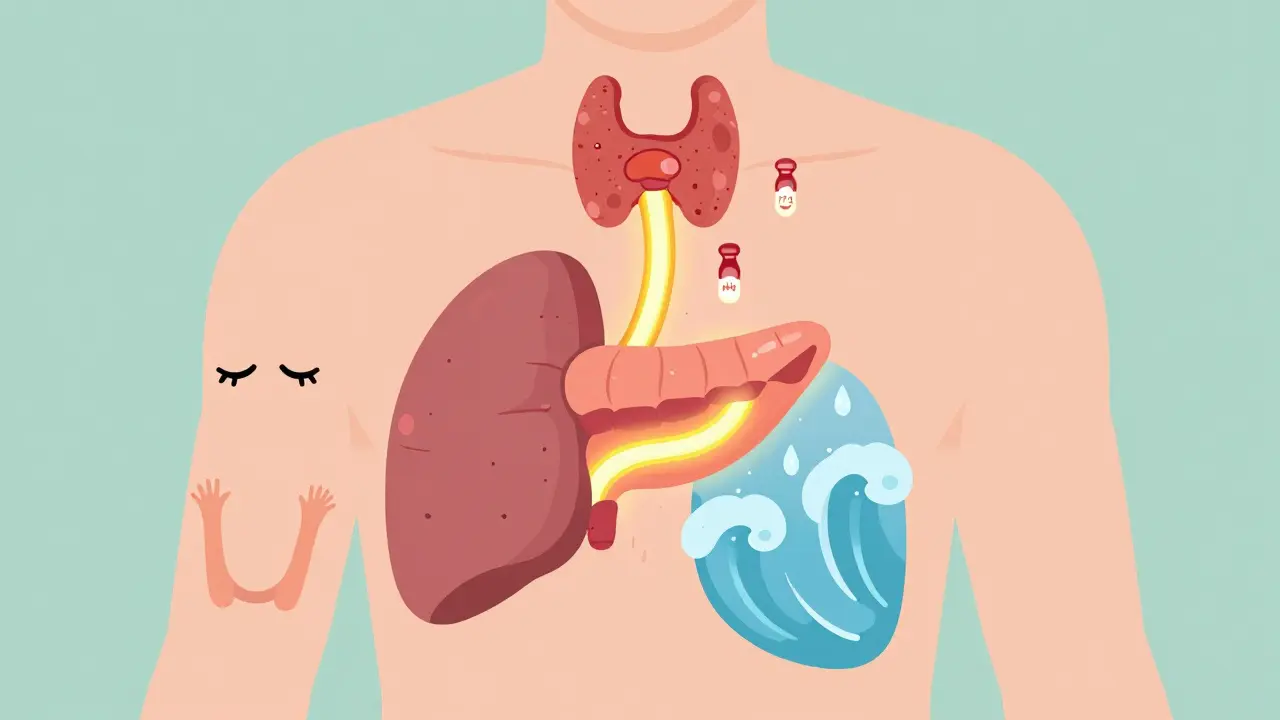
When your body’s energy system starts acting up-constant fatigue, unexplained weight changes, mood swings-it’s easy to blame one thing. Maybe it’s diabetes. Or maybe it’s your thyroid. But what if it’s both? Diabetes and thyroid disease don’t just happen side by side-they talk to each other, mess with each other, and make each other harder to control. If you’re managing one and still feel off, the other might be hiding in plain sight.
Why These Two Conditions Are Connected
Diabetes and thyroid disorders aren’t random coincidences. They’re both autoimmune in many cases. If your immune system attacks your insulin-producing cells (Type 1 diabetes), it’s also more likely to attack your thyroid. About 1 in 5 people with Type 2 diabetes have some form of thyroid dysfunction. For those with Type 1, the risk jumps to 5 to 10 times higher than the general population. That’s not a small overlap-it’s a pattern. Thyroid hormones directly affect how your body uses sugar. When your thyroid is underactive (hypothyroidism), your metabolism slows down. Glucose doesn’t get cleared from your blood as quickly. Insulin becomes less effective. Blood sugar climbs. When your thyroid is overactive (hyperthyroidism), your body burns through glucose too fast. You might feel jittery, lose weight, and then suddenly crash into low blood sugar-even if your insulin dose hasn’t changed. And it goes both ways. Diabetes can mess with your thyroid. High blood sugar damages nerves and blood vessels, including those that help convert T4 (the storage hormone) into T3 (the active one). This means even if your thyroid looks fine on paper, your body might not be using it right.Symptoms That Look the Same-But Aren’t
Here’s where things get tricky. Fatigue? Check. Weight gain? Check. Dry skin? Check. Hair loss? Check. Mood swings? Double check. These symptoms show up in both diabetes and thyroid disease. So when you’re told your high HbA1c is just from poor diet, but you’re eating right and still crashing-your thyroid might be the missing piece. A 2023 study from Apollo 247 found that 78% of people with both conditions reported extreme fatigue. That’s not normal tiredness. It’s the kind where you sleep 8 hours and still feel like you’ve run a marathon. Then there’s temperature intolerance. You’re always cold-even in summer-or sweating through your shirt at night. That’s not just menopause or stress. It’s your thyroid signaling trouble. Some signs are more unique to the combo:- Muscle cramps (33% of cases)-not just from dehydration, but from nerve damage and low calcium caused by thyroid imbalance.
- Hoarse voice (19%)-thyroid enlargement presses on your vocal cords.
- Poor memory or brain fog (45%)-not aging. This is metabolic slowdown affecting your brain’s energy supply.
How Thyroid Problems Change Your Diabetes Treatment
Your insulin dose isn’t set in stone. If your thyroid flips from underactive to overactive-or vice versa-your insulin needs can swing by 20% to 40%. That’s not a tweak. That’s a safety risk. In hyperthyroidism, your body burns insulin faster. You might need up to 30% more insulin just to stay in range. Miss that change, and your blood sugar skyrockets. In hypothyroidism, your body uses insulin more slowly. Your dose might be too high now. You could be walking around with low blood sugar all day and not even know it. One patient on DiabetesDaily.com, ‘SugarFree87’, shared: “After my hypothyroidism diagnosis, my insulin needs dropped by 30% overnight. I had three low blood sugar episodes in a week before my doctor caught it.” That’s not rare. It’s common. Medications interact too. Levothyroxine (the thyroid hormone replacement) is absorbed poorly if you have gastroparesis-a nerve problem from long-term diabetes. If your thyroid meds aren’t working, it might not be because you’re noncompliant. It’s because your stomach isn’t digesting them right.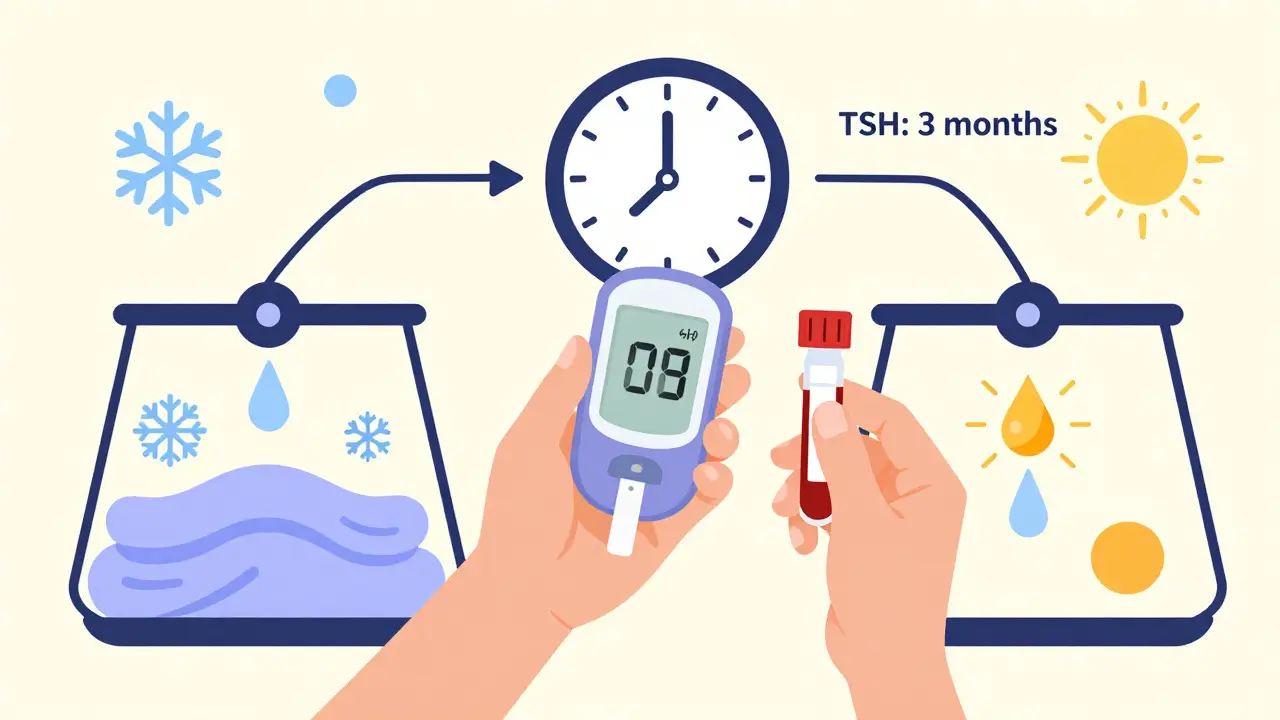
What You Should Be Testing-And How Often
If you have diabetes, you should be screened for thyroid disease. Not someday. Now. The American Diabetes Association recommends:- Annual TSH testing for all Type 1 diabetes patients.
- Annual TSH testing for Type 2 patients with risk factors: family history of thyroid disease, female gender, age over 50, or unexplained symptoms.
- Thyroid antibody tests (TPOAb, TgAb) at diagnosis-especially if you have Type 1. This tells you if you’re at risk for future thyroid problems, even if your TSH is normal now.
Diet, Lifestyle, and the Real Game-Changers
Medications help. But your daily habits do more. A 6-month trial published in PMC8787293 showed that sticking to a Mediterranean diet improved HbA1c by 0.8-1.2% and lowered TSH by 0.5-0.7 mIU/L. That’s not magic. It’s food that reduces inflammation, supports gut health, and balances hormones. Think olive oil, fatty fish, leafy greens, nuts, legumes, and berries. Cut the ultra-processed carbs. They spike your blood sugar and worsen thyroid inflammation. Sleep matters. Poor sleep raises cortisol, which worsens insulin resistance and suppresses thyroid function. Aim for 7-8 hours. Stress management isn’t fluffy advice-it’s medical. Chronic stress triggers autoimmune flares in both conditions. Exercise? Yes. But don’t overdo it. Too much intense cardio can stress your adrenal system and worsen thyroid fatigue. Focus on strength training and walking. Both improve insulin sensitivity and support thyroid hormone conversion.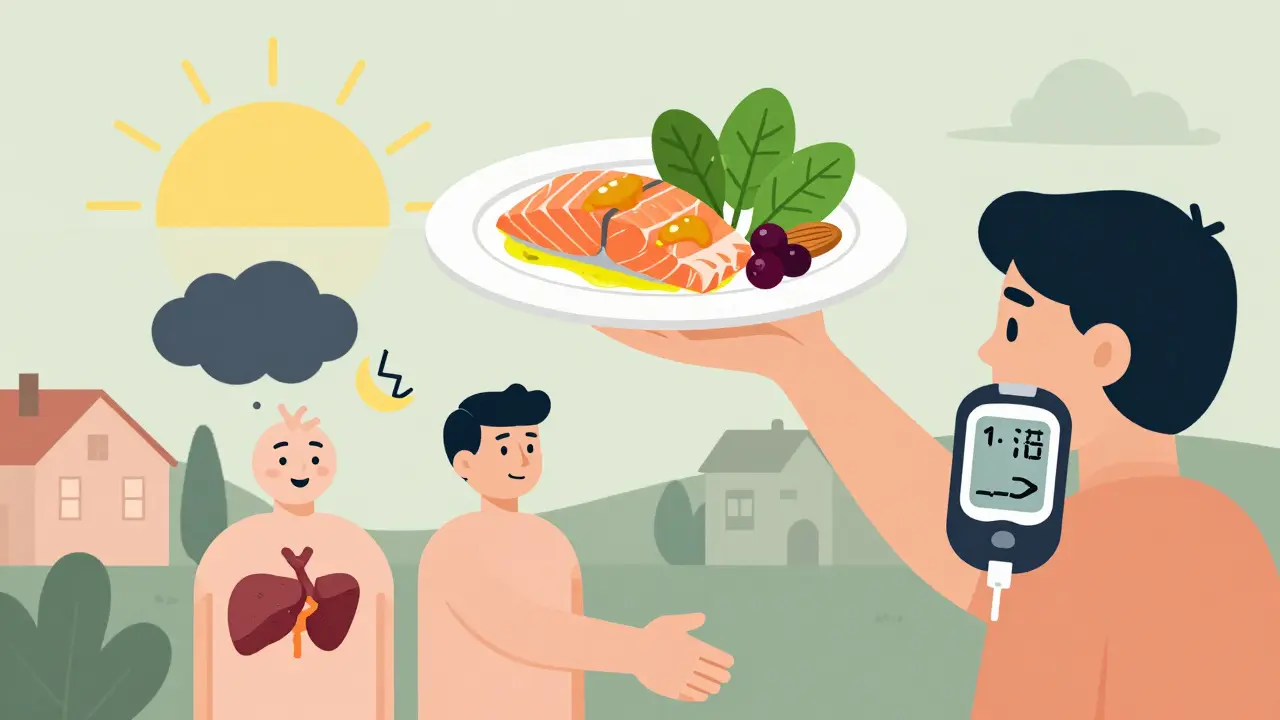
The Hidden Cost-And the Real Win
Having both diabetes and thyroid disease isn’t just harder to manage. It’s more expensive. Raval’s 2021 analysis found these patients pay $4,872 more per year in healthcare costs. Why? More ER visits. More hospitalizations. More complications like retinopathy, neuropathy, and heart disease. But here’s the good news: when you treat both, outcomes improve dramatically. Harvard Medical School found that properly managed thyroid function in diabetic patients cut hospital visits by 22% and emergency trips by 17%. That’s not just about feeling better. It’s about living longer. The future is integration. New research like the NIH’s TRIAD study is testing whether early thyroid treatment can delay or even prevent diabetes in high-risk people. GLP-1 agonists-drugs like semaglutide-are showing unexpected benefits for thyroid function too. In one 2024 pilot study, 63% of patients with subclinical hypothyroidism saw their TSH normalize after starting these diabetes meds.What to Do Right Now
If you have diabetes and feel like something’s still off:- Ask your doctor for a full thyroid panel: TSH, free T4, free T3, and thyroid antibodies.
- If you’re on insulin or other glucose-lowering meds, track your blood sugar with a CGM for at least 2 weeks. Look for unexplained lows or highs.
- Review your diet. Are you eating enough protein? Healthy fats? Fiber? Cut out the processed stuff.
- Get your sleep and stress levels in check. These aren’t lifestyle bonuses-they’re medical necessities.
- Don’t assume your symptoms are just from diabetes. Thyroid disease is sneaky. But once you find it, everything gets easier.
Can thyroid problems cause high blood sugar even if I don’t have diabetes?
Yes. Hypothyroidism slows down how your body uses glucose, leading to insulin resistance. This can push blood sugar levels into prediabetic or diabetic ranges-even in people who never had diabetes before. A 2023 study showed that 21.9% of people with thyroid dysfunction also had Type 2 diabetes, compared to 16.96% in the general population.
Why does my insulin dose keep changing without any diet or activity changes?
Thyroid hormone levels directly affect how fast your body uses insulin. If your thyroid becomes overactive, insulin is broken down faster, so you need more. If it becomes underactive, insulin lasts longer, so you need less. Unexplained changes in insulin needs are a red flag for thyroid dysfunction.
I have Type 1 diabetes. Do I need thyroid testing even if I feel fine?
Yes. People with Type 1 diabetes are 5-10 times more likely to develop autoimmune thyroid disease, even without symptoms. The American Diabetes Association recommends annual TSH and antibody testing for all Type 1 patients. Early detection prevents complications like heart disease and retinopathy.
Can levothyroxine interact with my diabetes medications?
Levothyroxine itself doesn’t directly interact with most diabetes drugs. But when your thyroid function changes, your insulin or oral medication needs change too. Also, if you have diabetic gastroparesis, levothyroxine may not absorb properly, making your dose ineffective. Always take it on an empty stomach, 30-60 minutes before food or other meds.
Is it safe to take supplements like selenium or iodine for thyroid health if I have diabetes?
Selenium may help reduce thyroid antibodies in autoimmune thyroid disease, but only if you’re deficient. Iodine can be dangerous-it can trigger hyperthyroidism in people with Hashimoto’s. Don’t self-supplement. Get tested first. Your doctor can guide safe dosing. Too much iodine can also worsen insulin resistance.
How do I know if my fatigue is from diabetes or my thyroid?
Fatigue from both conditions feels similar, but thyroid-related fatigue is often deeper and doesn’t improve with rest or sugar. If your blood sugar is stable but you’re still exhausted, with cold intolerance, dry skin, or brain fog, your thyroid is likely involved. A simple TSH test can confirm it.
Can managing my thyroid help me lose weight with diabetes?
Yes. Hypothyroidism slows metabolism and makes weight loss extremely difficult-even with strict dieting. Once thyroid levels are corrected, many people find it easier to lose weight. But don’t expect miracles. Weight loss still requires calorie control and movement. Thyroid treatment just removes a major barrier.
What’s the best way to monitor both conditions at home?
Use a continuous glucose monitor (CGM) to track blood sugar trends and catch hidden lows. For thyroid, keep a symptom journal: track energy, weight, temperature sensitivity, mood, and hair loss. Share both with your doctor every 3 months. Lab tests are essential, but your daily experience tells the real story.





Been dealing with both for years and honestly? The biggest game-changer was just getting my TSH checked. I thought I was just ‘bad at managing sugar’ until I found out my thyroid was basically napping on the job. Now I’m on levothyroxine, my CGM shows way fewer random lows, and I can actually finish a day without feeling like a zombie. No magic, just science.
Also, the Mediterranean diet thing? Real. Not because it’s trendy, but because it actually makes my body stop screaming at me. Olive oil, eggs, spinach - simple stuff. Cut the processed crap and your body will thank you.
And sleep? Don’t sleep less. Just sleep better. I started turning off screens an hour before bed and my brain fog lifted. Not hype. Just biology.
Let’s be real - this whole ‘thyroid and diabetes are besties’ narrative is overblown. Sure, there’s overlap, but most people just have bad habits and then blame their organs. I’ve seen 30-year-olds with HbA1c of 9.5 who eat nothing but protein shakes and blame their thyroid. Wake up. Your insulin resistance isn’t caused by your thyroid - it’s caused by your fridge.
And CGMs? Cool gadget. Doesn’t fix poor choices. Stop outsourcing responsibility to your endocrine system.
Ah, the sacred dance of the autoimmune symphony - where the pancreas and thyroid, two wounded gods of metabolic divinity, entwine in a tragic ballet of molecular betrayal. We are not merely patients; we are living archives of immune miscommunication, each cell a whispered plea for homeostasis in a world that demands relentless efficiency.
Consider the T4-to-T3 conversion - not merely a biochemical step, but a metaphysical translation of vitality into usable energy. When your liver, weary from years of fructose-induced exile, fails to perform this alchemy, your brain becomes a dimly lit library with no librarian. You are not tired. You are *untranslated*.
And let us not forget the levothyroxine absorption crisis - a silent siege waged by gastroparesis, that cruel architect of biochemical sabotage. Your pills sit there, unacknowledged, like love letters tossed into a storm.
Perhaps the real diagnosis isn’t hypothyroidism or diabetes - but the systemic collapse of our modern relationship with food, sleep, and the sacred silence between breaths. We are not broken. We are misunderstood.
I had no idea my brain fog was linked to my thyroid until I got tested. My HbA1c was fine but I was still exhausted. TSH was 6.8. Changed everything.
Now I take my meds on an empty stomach and I actually sleep through the night. No more 3 a.m. panic spikes. Just quiet. Just balance.
Oh, so now we’re blaming the thyroid for everything? Let me guess - you also think your bad posture is caused by ‘adrenal fatigue’ and your anxiety is ‘thyroid-induced cortisol chaos.’ Please. You’re not a medical mystery. You’re just lazy and eating too much bread.
And ‘Mediterranean diet’? That’s just a fancy way of saying ‘I eat avocado toast and call it healing.’ You don’t need a 2023 study - you need a scale and a mirror. And maybe a therapist.
Also, CGMs? For people who can’t count carbs? Pathetic. I’ve been managing Type 1 since 1998. No fancy gadgets. Just discipline. And you? You’re just looking for excuses.
It is, in fact, a curious phenomenon that the intersection of autoimmune thyroid disease and diabetes mellitus has been so thoroughly documented in peer-reviewed literature - yet, in clinical practice, screening remains inconsistent. One might reasonably infer that this disparity reflects a systemic failure in primary care protocols rather than a lack of evidence.
Furthermore, the assertion that levothyroxine absorption is compromised in gastroparesis is not merely plausible - it is mechanistically sound, as gastric motility directly influences drug dissolution kinetics. Yet, how many endocrinologists routinely inquire about meal timing or gastric symptoms when adjusting thyroid replacement dosages?
One must ask: Is this oversight due to ignorance, or simply inertia?
As someone who has lived in four countries and managed both conditions across three continents, I can confirm: the science is universal, but the access is not.
In the U.S., you get CGMs and TSH panels on demand. In rural India, where I lived for a year, patients rely on monthly clinic visits and finger-prick tests that cost half a day’s wages. The fact that we’re even having this conversation in English, with peer-reviewed studies cited, is a luxury.
Let’s not forget that thyroid dysfunction is more common in women - and women are more likely to be told they’re ‘just stressed’ or ‘overreacting.’ This isn’t just medicine. It’s gendered health inequality.
So yes - get tested. But also demand that your healthcare system doesn’t treat your symptoms like a puzzle you’re supposed to solve alone.
They don’t want you to know this, but the CDC and ADA are in bed with Big Pharma. Levothyroxine is a billion-dollar industry. They don’t want you to know that fluoride in your water suppresses thyroid function - and that’s why diabetes rates are rising. Same with glyphosate. It’s not your diet. It’s the chemicals.
And CGMs? They’re tracking you. Every spike, every low - all feeding into a national health database that’s used to raise your insurance premiums. You think you’re getting help? You’re being mined.
Stop taking pills. Start drinking apple cider vinegar. And get a water filter. That’s the real solution.
The integration of thyroid and diabetes care represents a critical evolution in metabolic medicine. Clinical guidelines have long treated these conditions in isolation, despite well-established pathophysiological interdependencies.
It is imperative that primary care providers adopt a holistic screening protocol: TSH, free T4, free T3, and thyroid peroxidase antibodies at diagnosis for all Type 1 patients, and for Type 2 patients presenting with unexplained metabolic instability.
Moreover, the use of continuous glucose monitoring is not merely an adjunct - it is a diagnostic tool that reveals patterns invisible to HbA1c alone. The data is unequivocal: integrated management improves outcomes, reduces complications, and enhances quality of life.
Let us move beyond siloed care. The evidence is clear. The time for action is now.
I didn’t believe it either until I started tracking my symptoms. I thought I was just ‘bad at dieting’ - turns out my thyroid was in slow motion. Once I got my meds right, the weight started coming off, my mood stabilized, and I actually felt like myself again.
It’s not about being perfect. It’s about being consistent. And asking for help. You’re not broken. You’re just missing a piece.
Just got my TSH results back - 7.1. Been feeling like crap for months. Took me forever to get tested. Don’t wait like I did. Ask your doc. It’s a simple blood test. One result can change your whole life.
And yeah, the diet thing? Real. Cut the junk. Move your body. Sleep. It’s not rocket science. It’s just hard when you’re tired all the time.
You got this.
They’re hiding the truth. Thyroid disease isn’t just linked to diabetes - it’s being weaponized. The government knows that when your thyroid fails, you’re more likely to rely on insulin, which means more profits for the pharmaceutical complex. They don’t want you to know that selenium can reverse Hashimoto’s - they want you dependent on levothyroxine forever.
And CGMs? They’re not for your health. They’re for data mining. Your glucose spikes are being sold to insurers. Your body is a product. Wake up.