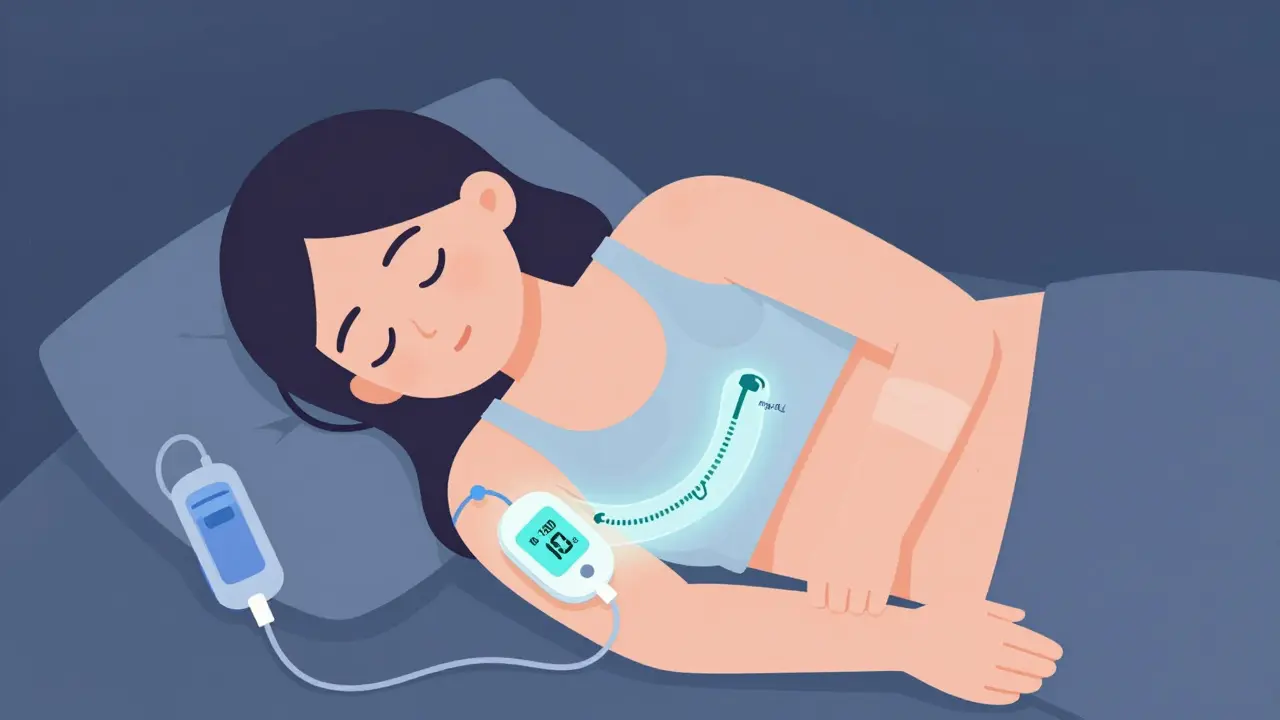
For people with type 1 diabetes, managing blood sugar has always been a constant, exhausting job. You count carbs. You check glucose. You inject insulin. You adjust for exercise, stress, sleep, meals, and surprises. Then came closed-loop systems - and everything changed. These aren’t sci-fi gadgets. They’re FDA-approved medical devices that do the math for you, 24/7. They watch your glucose levels with a sensor, calculate what your body needs, and automatically deliver insulin through a pump. No more guessing. No more midnight panic checks. Just better control, more sleep, and less mental load.
How Closed-Loop Systems Actually Work
At its core, a closed-loop system is three things working together: a continuous glucose monitor (CGM), an insulin pump, and an algorithm. The CGM checks your blood sugar every 5 minutes. The algorithm looks at the trend - is your glucose rising fast? Dropping slow? Stable? - and tells the pump to give more insulin, less insulin, or pause entirely. It’s not magic. It’s math. But it’s math that works in real time, in your body.
Most systems today are called hybrid closed-loop. That means they handle your background (basal) insulin automatically - but you still have to tell them when you eat. You press a button on your phone or pump, enter how many carbs you’re eating, and the system gives a correction bolus. It’s not fully automatic yet. But it’s a huge leap from where we were. Before these systems, even the best insulin pumps just delivered preset doses. You were still doing all the thinking.
Real Results: What the Numbers Say
Let’s talk numbers, because they’re not theoretical. They’re from real people, in real life.
Before using a closed-loop system, most people with type 1 diabetes spend about 50-60% of their day in the target glucose range (70-180 mg/dL). That’s less than half the day. After switching to a hybrid closed-loop system like Tandem’s Control-IQ or Insulet’s Omnipod 5, that jumps to 70-75%. That’s 3-4 extra hours a day where your blood sugar is safe and stable.
Time spent below 70 mg/dL - the danger zone for hypoglycemia - drops from 5-7% to 2-4%. That means fewer lows. Fewer emergency glucagon kits. Fewer panic calls to your partner at 3 a.m. HbA1c, the long-term blood sugar average, falls by 0.3-0.5%. That might sound small, but it’s the difference between a 7.7% and a 7.3% - a level that cuts your risk of nerve damage, kidney problems, and vision loss.
A 2023 study in The Lancet Diabetes & Endocrinology followed over 1,200 users. Those on hybrid closed-loop systems had 11.2% more time in range than those on traditional pumps. Hypoglycemic events dropped by 37%. That’s not a trend. That’s a revolution.
Key Systems Compared: Control-IQ, Omnipod 5, and iLet
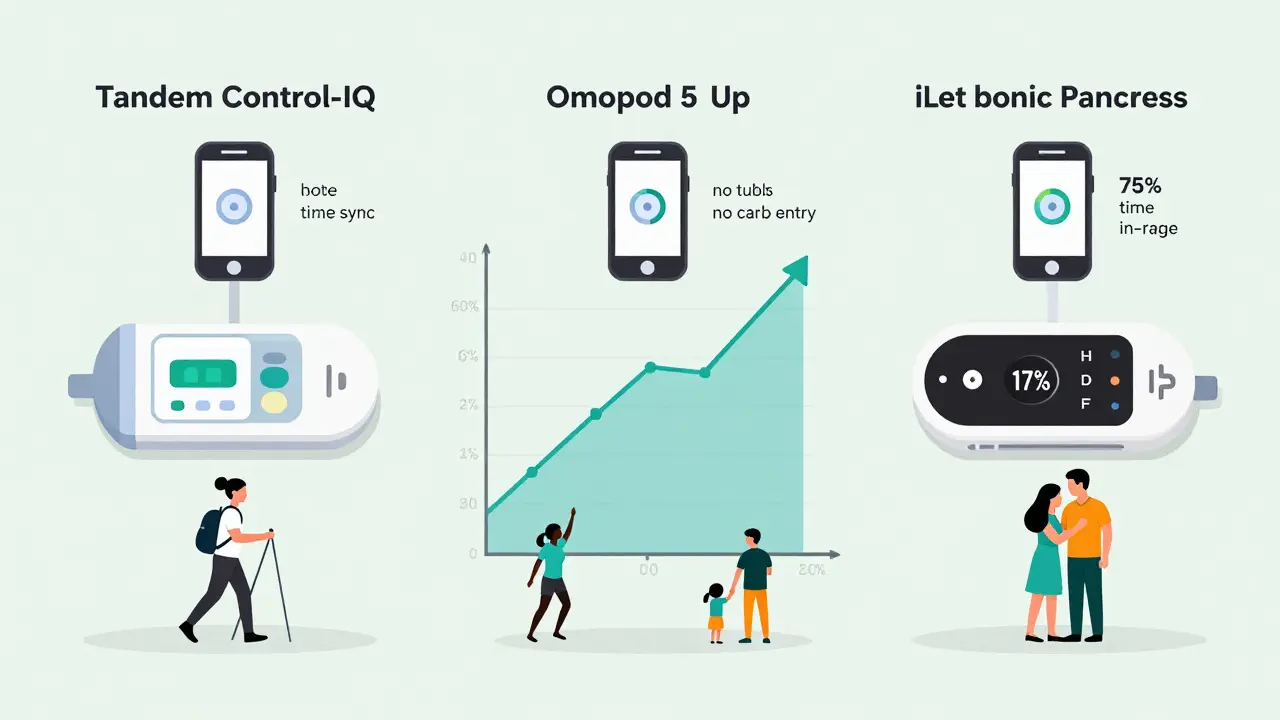
Not all closed-loop systems are the same. Here’s how the top three stack up:
| System | Company | Meal Bolus Required? | Setup Complexity | Insulin Capacity | Annual Cost (Est.) |
|---|---|---|---|---|---|
| t:slim X2 with Control-IQ | Tandem Diabetes Care | Yes, but can auto-correct | Medium | 300 units | $3,500-$4,000 |
| Omnipod 5 | Insulet | Yes (now optional with ‘Autonomous’ mode) | Low | 150 units per pod | $3,800-$4,500 |
| iLet Bionic Pancreas | Beta Bionics | No - fully automated | Lowest - only weight needed | 300 units | $5,000+ |
Control-IQ stands out because it doesn’t just wait for you to bolus. If your glucose spikes after a meal you forgot to announce, it can automatically give a correction dose. Omnipod 5 is a tubeless patch pump - no wires, no pump to carry. You just stick it on. And iLet? It’s the closest thing to a true artificial pancreas. You only need to enter your weight. No carb counting. No insulin ratios. The system learns your body over time. It’s not perfect - it still recommends meal announcements for best results - but it removes the biggest barrier for many users.
Real People, Real Lives
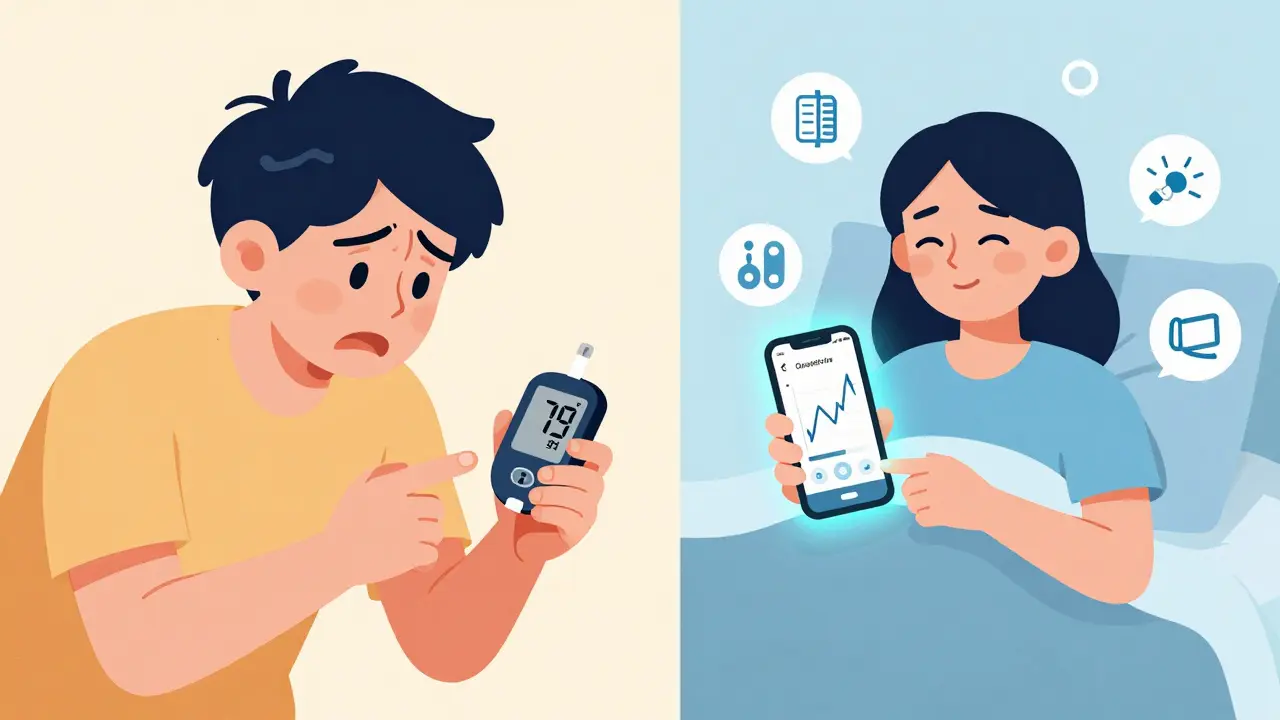
On the T1D Exchange Forum, 78% of users said their sleep improved after switching. One mom wrote: “I haven’t had a severe low in 8 months. Before, I had one every month. I used to wake up every night checking my daughter’s glucose. Now I sleep through the night.”
On Reddit’s r/insulinpumps, users talk about stability. “My morning sugars are consistent for the first time ever,” said one user. “I used to start every day with a 200+ reading. Now I’m in the 90s.”
But it’s not perfect. Forty-two percent of negative reviews on DiabetesMine mention poor post-meal control. The system might not react fast enough to a big pasta dinner. Some users report delays of 15-20 minutes before insulin kicks in. Others deal with sensor errors - a faulty reading can cause the algorithm to overcorrect or undercorrect. One user on TuDiabetes.org said: “I had to turn off automation three times last week because the sensor said I was dropping when I wasn’t.”
People with unpredictable schedules - shift workers, parents of young kids, athletes - report higher abandonment rates. If your meals are random, your glucose is random, and the system can’t keep up. That’s not the system’s fault. It’s a limitation of current tech.
What You Need to Know Before Starting
Getting a closed-loop system isn’t like buying a new phone. It’s a medical device with a learning curve.
- You’ll need a smartphone (iOS 13+ or Android 8+)
- You must be comfortable with CGM sensors - they need replacing every 7-14 days
- You still need to know your insulin-to-carb ratio and correction factor
- Initial setup takes 3-5 hours: calibrating sensors, priming the pump, syncing the app
- Expect 2-4 weeks to get comfortable with the system’s behavior
Common problems? Sensor adhesion issues (38% of users), calibration errors (15%), and the algorithm misreading exercise. Solutions? Use Skin Tac under your sensor. Pre-bolus 15-20 minutes before high-carb meals. Use exercise mode to temporarily reduce insulin delivery.
Training matters. Forty-five percent of users in a Diabetes UK survey said they didn’t get enough initial instruction. Don’t assume your endocrinologist will walk you through it. Ask for a certified diabetes educator. Use manufacturer support lines - Tandem’s average response time is under 10 minutes.
Cost, Access, and the Future
These systems aren’t cheap. The t:slim X2 pump costs around $6,500. The Omnipod 5 pods cost $320 every 3 days. Add in sensors, supplies, and software subscriptions, and annual costs run $3,500-$5,000. Medicare covers 80%. You pay the rest. Private insurers vary. Many people can’t afford it.
But adoption is rising. In the U.S., 28% of insulin pump users now use a closed-loop system. Among kids, it’s 35%. The global market is projected to hit $5.7 billion by 2030.
The future? Fully automated systems. Omnipod 5’s ‘Autonomous’ mode, currently in beta, eliminates meal announcements. Tandem’s Control-IQ 3.0, released in late 2023, reduces hypoglycemia by another 1.8%. Beta Bionics is testing algorithms that respond to stress and activity - not just glucose. The goal: a system that doesn’t just react, but predicts.
Still, there are risks. A 2023 study found a 1.2x higher rate of diabetic ketoacidosis (DKA) in closed-loop users. Why? If the pump fails or the sensor disconnects, the system stops insulin. If you don’t notice, your blood sugar can spike dangerously. That’s why education is critical. Know the signs. Check your pump. Test your blood sugar manually if you feel off.
Is It Right for You?
If you’re tired of constant glucose checks. If you’re afraid of lows. If you want to sleep through the night without waking up to a beeping alarm. If you’re ready to trade manual calculations for automated control - then yes, it’s worth exploring.
But if you hate tech. If you can’t commit to daily sensor changes. If your life is too unpredictable for a system that needs structure - wait. The tech is getting better. In five years, it’ll be even easier.
Right now, closed-loop systems aren’t perfect. But they’re the closest thing to a cure we’ve ever had for type 1 diabetes. They don’t eliminate the disease. But they let you live with it - without letting it live with you.
Do closed-loop systems work for type 2 diabetes?
Currently, hybrid closed-loop systems are FDA-approved only for people with type 1 diabetes. While some type 2 users on insulin are experimenting with these systems off-label, they’re not officially recommended. Research is ongoing, but the algorithms are trained on type 1 physiology - which is very different from type 2. If you have type 2 and use insulin, talk to your doctor about whether it’s a safe option for you.
Can I use any CGM with any pump?
Not yet. Today’s systems are closed ecosystems. Tandem’s Control-IQ only works with Dexcom G6 or G7. Omnipod 5 only works with Dexcom G6. Beta Bionics’ iLet works with Dexcom G6 and Freestyle Libre 2. Interoperable systems - where you can mix and match brands - are expected in 2025. Until then, you’re locked into the manufacturer’s approved sensors.
How often do I need to replace the pump or pod?
Tandem’s t:slim X2 pump lasts 3-5 years with proper care. You’ll need to replace the insulin reservoir and tubing every 2-3 days. Omnipod 5 is a disposable pod - you replace the entire unit every 3 days. Beta Bionics’ iLet pump is reusable, but you refill the insulin reservoir every 2-3 days. Sensor replacement is every 7-14 days, depending on the brand.
Do these systems work during exercise?
Yes - but they’re not perfect. Exercise can cause glucose to drop quickly. Most systems have an “exercise mode” that reduces basal insulin. But if you’re doing high-intensity or prolonged activity, you may still need to manually adjust. Some users report delays in response during intense workouts. Always test your glucose before, during, and after exercise. Don’t rely on automation alone.
What happens if my phone dies?
The pump keeps running. Control-IQ and Omnipod 5 both store glucose data and insulin delivery history locally. If your phone dies, the system continues to function normally. You just won’t be able to see live readings or make manual adjustments until you recharge or replace the phone. Always carry a backup glucose meter and a charged phone if possible.
Are closed-loop systems safe for children?
Yes. In fact, children and teens have some of the highest adoption rates. Studies show improved time-in-range, fewer hospitalizations, and better school performance. Parents report less nighttime anxiety. The systems are designed with safety limits to prevent over-delivery. Most pediatric endocrinologists now recommend them as first-line therapy for eligible children.
Can I travel with a closed-loop system?
Absolutely. TSA allows these devices through security. Carry your pump and CGM in your carry-on. Bring extra sensors, batteries, and insulin. Always have a backup plan - manual injections, a glucometer, and glucagon. Some users report sensor issues on long flights due to pressure changes. Test your glucose more often during travel. Keep your phone charged and Bluetooth enabled.
What’s the biggest drawback?
The biggest drawback is still the need for manual input - especially for meals. Even the best systems can’t perfectly predict what you’ll eat. If you forget to bolus, or miscount carbs, your glucose will spike. That’s why education and consistency matter. The system reduces your workload - but it doesn’t remove your responsibility. You still have to be the boss of your diabetes.
For people with type 1 diabetes, closed-loop systems aren’t just a tool. They’re a lifeline. They don’t cure the disease. But they give back time, sleep, peace of mind - and the freedom to live without constant fear. The technology is here. The question isn’t whether it works. It’s whether you’re ready to let it work for you.







I switched to Control-IQ last year. My HbA1c dropped from 8.1 to 7.2. I sleep through the night now. No more 3 a.m. panic checks. It’s not perfect, but it’s the closest thing to normal I’ve had in 18 years.
If you're on the fence, just try it for 30 days. The tech isn't magic, but it's the best tool we've ever had. I used to wake up with highs every morning. Now I'm consistently in range. Your pancreas is gone - let the algorithm do the heavy lifting.
i got the omnipod 5 and it was a game changer except the sensor keeps falling off my arm. i use skin tac now and it works better. also i still forget to bolus for pizza lol
The advancement in closed-loop technology represents a monumental leap in medical science. It is not merely a device; it is a paradigm shift in the management of Type 1 Diabetes Mellitus. The reduction in hypoglycemic events, coupled with improved time-in-range, demonstrates statistically significant clinical benefits. One must acknowledge the rigorous engineering and clinical validation behind these systems.
I’ve been using Control-IQ for 8 months. The biggest win? My kid’s school nurse doesn’t have to call me every time his glucose dips. The system handles it. Still, I wish the algorithm reacted faster to high-fat meals. Pasta still messes with it.
People act like this is some miracle cure. It’s just another gadget. You still have to think. You still have to eat right. You still have to take responsibility. Stop outsourcing your health to a machine that can glitch at 2 a.m.
so i got the iLet and i thought it was gonna be magic. turns out i still have to tell it when i eat. kinda sucks. why call it fully automated if i still have to press buttons?
They’re selling this like it’s the second coming. But let’s be real - these systems are just glorified insulin calculators. And when they fail? You’re left with a dead pump and a blood sugar that’s climbing like a rocket. I’ve seen people in DKA because they trusted the algorithm too much. Don’t be fooled.
You know, this tech reminds me of the old African proverb - 'The tool does not carry the hand.' The system doesn’t cure diabetes. It just gives you back your life. I used to feel like a prisoner to my glucose meter. Now I can go for a walk without checking every 20 minutes. That’s not just science. That’s freedom.
just moved from usa to indonesian and had to switch to libre 2 with omnipod 5. worked fine but the app kept disconnecting. had to use a vpn to get the dexcom sync working. also, the humidity here kills my sensors faster. worth it though.
I love the Omnipod 5. No wires, no pump to carry. And the emoji alerts? 😍 So satisfying when it says 'Good job, you’re in range!' I feel like my pump is my little diabetes coach.
So let me get this straight - we spent 100 years treating diabetes with needles and guesswork, and now we have a machine that does the math... and people still act like it’s a miracle? I mean, it’s just code. But hey, if it lets me sleep, I’ll take it. Even if it’s not perfect.
I got the iLet and honestly? I forgot to enter my weight the first week. The system still worked. It adjusted on its own. That blew my mind. I thought I’d have to micromanage everything. Turns out, it’s smarter than I am.
Too much info. I just want to know if it works. Answer: yes. I'm done.
This is how they control us. Big Pharma + Silicon Valley. They sell you a $5,000 gadget so you think you’re getting better - while they make you dependent. They don’t want a cure. They want a subscription. Look at the cost. Look at the lock-in. This isn’t progress. It’s exploitation.