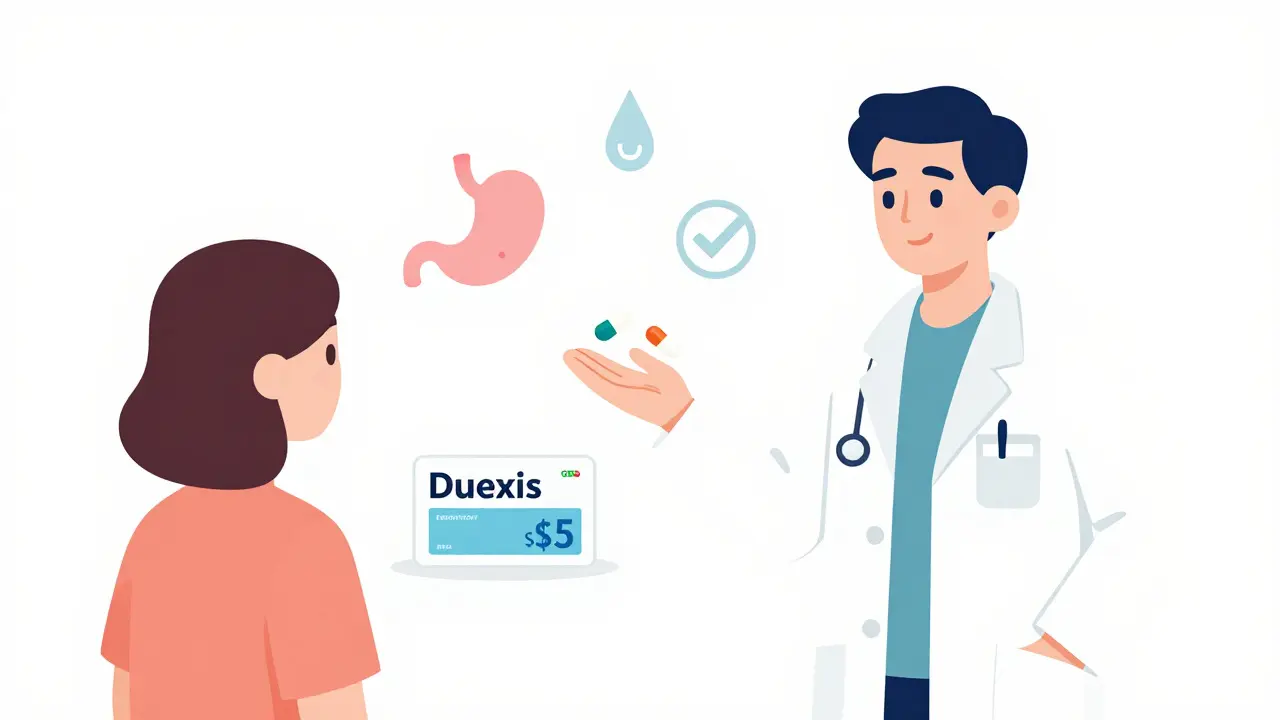
When you’re dealing with stomach pain, acid reflux, or ulcers, doctors often prescribe gastrointestinal combination products-medicines that pack two or more active ingredients into one pill. Why? Because some conditions don’t respond well to just one drug. Take H. pylori infections: they need both an acid blocker and antibiotics to truly clear up. Or someone with arthritis who also gets stomach ulcers-they need pain relief without the damage. That’s where combination drugs come in. But here’s the real question: are there affordable generics? And what if the brand-name version doesn’t work or is too expensive?
What Are Gastrointestinal Combination Products?
These aren’t random mixes. They’re carefully designed to work together. For example, ibuprofen and famotidine (sold as Duexis) combines a painkiller with a stomach-protecting acid reducer. The ibuprofen eases joint pain, while the famotidine lowers stomach acid to prevent ulcers-a common side effect of long-term NSAID use. The FDA approved this combo in 2021, with each tablet containing 800 mg of ibuprofen and 26.6 mg of famotidine. Another big category is H. pylori eradication therapy. This usually means a proton pump inhibitor (PPI) like omeprazole or esomeprazole paired with two antibiotics-commonly amoxicillin and clarithromycin. The PPI reduces acid so the antibiotics can kill the bacteria more effectively. These regimens are standard care, but dosing matters: MassHealth limits omeprazole to no more than four 20 mg capsules per day unless you have a serious condition like Zollinger-Ellison syndrome. Newer drugs like vonoprazan (Voquezna), approved in July 2024, represent a shift. Unlike traditional PPIs, it’s a potassium-competitive acid blocker. It works faster and lasts longer, making it ideal for heartburn from nonerosive GERD. But because it’s new, it’s still under patent protection-no generics yet.Generic Availability: What’s Available and What’s Not
The good news? Many standalone ingredients in these combos have cheap generics. Omeprazole, lansoprazole, and pantoprazole are all available as generics with FDA “A” ratings-meaning they’re bioequivalent to the brand. Same with amoxicillin and clarithromycin. But the fixed-dose combinations? That’s trickier. The ibuprofen-famotidine combo got its first generic in August 2021, approved for Par Pharmaceutical and later Alkem Laboratories. If your pharmacy stocks it, you can save hundreds per month compared to the brand. But not all pharmacies carry it right away. The FDA approves the drug, but manufacturers don’t always rush to produce it. Always call ahead. On the other hand, Linzess (linaclotide) for IBS-C got a generic in February 2021 from Mylan. That’s a win for patients who need daily relief from constipation and abdominal pain. Now, what’s still blocked? Janumet (sitagliptin + metformin) is expected to go generic in 2026. Xifaxan (rifaximin) lost exclusivity in 2024 after 20.7 years, so generics should be rolling out now. But newer drugs like vonoprazan and maralixibat (Livmarli) are still under patent. No generics yet. And biosimilars like pyzchiva (ustekinumab-ttwe), approved in July 2024, are only for biologics-used in Crohn’s and ulcerative colitis-not traditional oral combos.Why Some Combos Are Harder to Get as Generics
It’s not just about patents. The FDA treats each unique combination as its own drug. That means Janumet (sitagliptin + metformin) is legally different from Januvia (sitagliptin alone). So even if metformin has been generic for decades, the combo didn’t become eligible until the patent on sitagliptin expired. Also, manufacturers sometimes delay generics by filing legal challenges or extending patents with minor reformulations. This is called “evergreening.” It’s legal, but it keeps prices high. Then there’s the issue of demand. If a combo is only used by a small group-like patients with rare liver diseases taking Livmarli-there’s little incentive for generics to enter. The market isn’t big enough to justify the cost of testing and approval.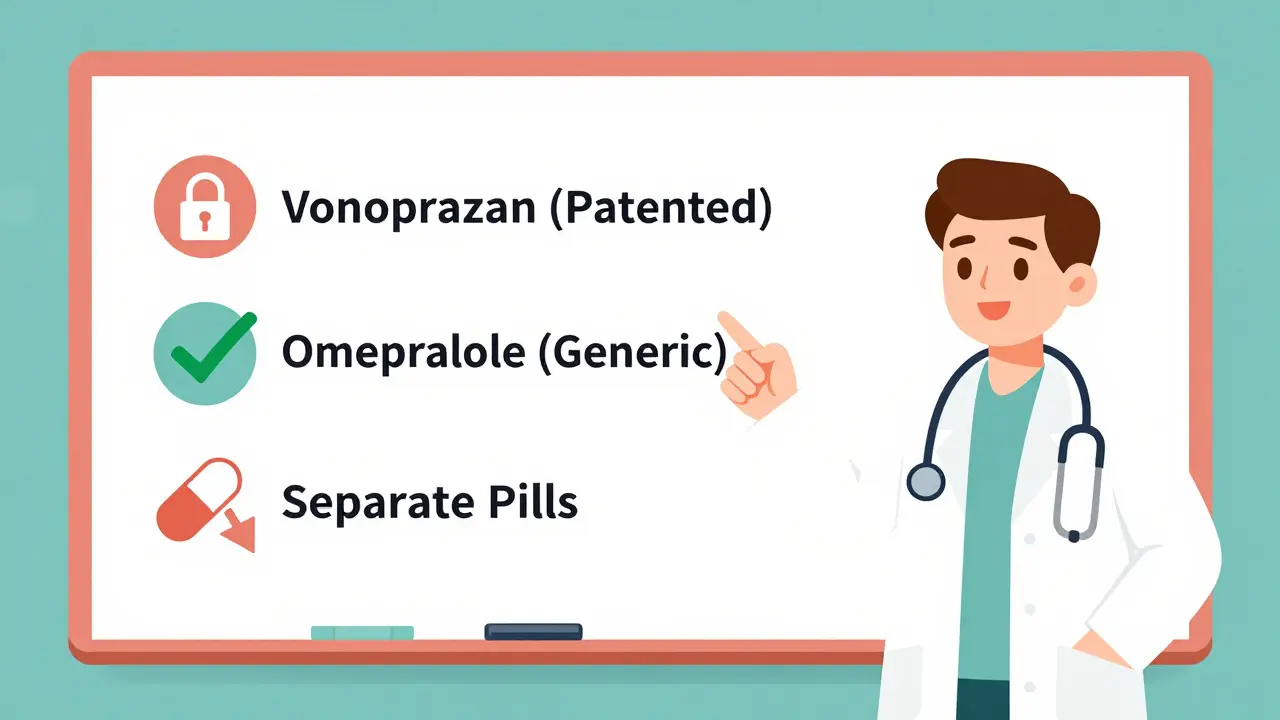
Alternatives When Generics Aren’t Available
If your insurance won’t cover the brand-name combo, or it’s too expensive, here’s what you can do:- Take the ingredients separately. For example, if you need ibuprofen and famotidine but the combo isn’t available, ask your doctor for a prescription for both pills. You’ll pay less, and you can adjust doses independently. This is common practice-especially for H. pylori regimens.
- Try a different PPI. If vonoprazan is out of reach, omeprazole, esomeprazole, or rabeprazole may work just as well. The MHDL notes that rabeprazole under one daily dose often doesn’t require prior authorization, making it easier to access.
- Switch to over-the-counter options. For mild heartburn or diarrhea, OTC loperamide (Imodium) or famotidine (Pepcid AC) can help. But don’t use them long-term without medical advice.
- Ask about patient assistance programs. Companies like AbbVie and Takeda offer savings cards or free drug programs for eligible patients. Check their websites or ask your pharmacist.
How Insurance and Prior Authorization Work
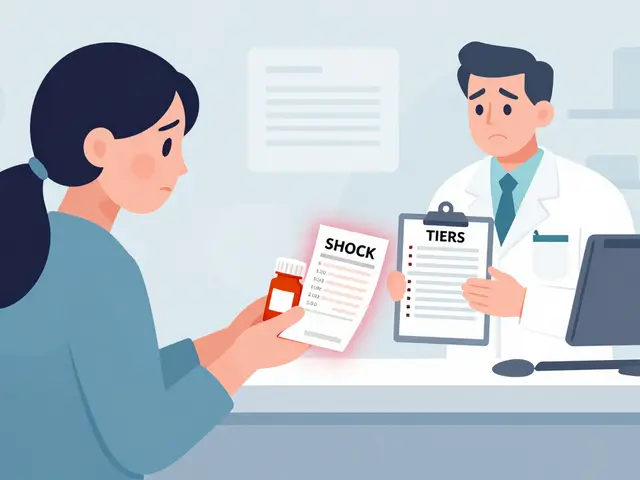
Don’t be surprised if your pharmacy says “prior authorization required.” That’s because insurers control access. MassHealth, for example, requires documentation if you need more than one capsule of esomeprazole per day for simple GERD. But if you have Barrett’s esophagus or a history of ulcers, they’ll approve it without hassle. The same applies to brand-name combos. If you’ve tried the generic version and had side effects or no improvement, your doctor can submit medical records to justify the brand. This is how many patients get access to drugs like Duexis or Linzess when generics aren’t working. But here’s the catch: drugs with guaranteed Part D formulary placement don’t offer big rebates. That means even if a drug is “covered,” the price might still be high. Medicare’s new negotiation program is changing this-some drugs will see price cuts soon. But it’s slow. Janumet’s price drop won’t happen until 2026.
What to Do If Your Combo Isn’t Working
If you’re on a combination drug and still having symptoms, don’t just up the dose. Talk to your doctor. Many patients end up on higher-than-recommended doses of PPIs because they weren’t given alternatives. For example:- If acid reflux persists despite PPIs, consider dietary triggers-caffeine, spicy food, eating late at night.
- If you’re on antibiotics for H. pylori and still testing positive, you may have resistant strains. A different combo (like adding metronidazole) might be needed.
- If you’re on Linzess and get severe diarrhea, switching to plecanatide (Trulance) might help-it’s another guanylate cyclase agonist with fewer side effects.
Future Trends: What’s Coming Next
The GI drug market is growing fast-projected to hit $96 billion by 2035. Why? More people have GERD, IBS, and inflammatory bowel disease. And new drugs are coming. Biologics like risankizumab-rzaa (for Crohn’s and ulcerative colitis) are expanding. These are injectables, not pills, but they’re changing outcomes for severe cases. They’re expensive-$20,000+ a year-but they work when nothing else does. Meanwhile, researchers are testing new combos: PPIs with novel antibiotics, or even gut microbiome modulators paired with anti-inflammatories. The goal? Fewer pills, better results. For now, your best move is to know what’s available, ask for generics, and don’t be afraid to ask for alternatives. The system isn’t perfect, but you have more power than you think.Are there generic versions of ibuprofen and famotidine combination pills?
Yes. Generic versions of the ibuprofen-famotidine combination (brand name Duexis) were approved by the FDA in August 2021. Companies like Par Pharmaceutical and Alkem Laboratories now manufacture them. These generics are FDA-approved as bioequivalent, meaning they work the same way. They’re significantly cheaper than the brand-name version. However, not all pharmacies stock them immediately, so it’s best to call ahead or ask your pharmacist to order it.
Why can’t I get a generic for vonoprazan yet?
Vonoprazan (brand name Voquezna) was approved by the FDA in July 2024. It’s a new type of acid blocker, different from traditional PPIs, and still under patent protection. Generic versions won’t be available until the patent expires-likely around 2030 or later. Until then, if you need an alternative, your doctor may recommend omeprazole, esomeprazole, or rabeprazole, which are all available as generics and work well for most people with GERD.
Can I just take the individual drugs instead of the combo pill?
Absolutely. Many patients take the separate ingredients-like ibuprofen and famotidine, or omeprazole and amoxicillin-instead of the combo pill. This gives you more control over dosing and often costs less. Insurance may also cover the individual drugs more easily. Your doctor can write separate prescriptions, and your pharmacist can help you time the doses correctly. This is a common and safe practice, especially when the combo isn’t available or too expensive.
Why does my insurance require prior authorization for some GI drugs?
Insurance companies use prior authorization to control costs and prevent overuse. For example, if you request more than one daily dose of esomeprazole for simple heartburn, they’ll ask for proof you’ve tried cheaper options first or have a serious condition like Barrett’s esophagus. They also require documentation if you’re asking for a brand-name drug when a generic is available. This isn’t meant to block care-it’s meant to make sure you’re getting the right treatment at the right price.
What should I do if my combination drug isn’t helping?
Don’t increase the dose on your own. Talk to your doctor. You might need a different combination, a non-drug approach, or a switch to another class of medication. For example, if PPIs aren’t controlling your reflux, you might benefit from dietary changes, weight loss, or even a trial of vonoprazan once it becomes available as a generic. If you’re on antibiotics for H. pylori and still have symptoms, you may need a different antibiotic combo. Always get tested before making changes.
Are there over-the-counter alternatives to prescription GI combination drugs?
For mild symptoms, yes. Loperamide (Imodium) is OTC for diarrhea. Famotidine (Pepcid AC) and omeprazole (Prilosec OTC) are available without a prescription for occasional heartburn. But these aren’t substitutes for prescription combos used for chronic conditions like H. pylori, arthritis-related ulcers, or IBS. OTC versions are lower-dose and meant for short-term use. If you need them daily for more than two weeks, see a doctor.




Let me get this straight-you’re telling me I can just buy two separate pills and save hundreds? And the pharma companies are fine with this? They literally designed this combo to lock us in. It’s not medicine, it’s a subscription model for your stomach. I’ve been taking ibuprofen and famotidine separately for years. My doctor never even mentioned the combo. Why? Because they know the generics work better and cost less. The system is rigged, and we’re the ones paying for it.
I get why the combo exists. It’s convenient. But I’ve also seen people get confused taking two pills at once and then blame the meds. Still, taking them separate gives you control. If one pill messes with your sleep and the other doesn’t, you can adjust. I switched from Duexis to generic ibuprofen + famotidine last year. Saved $200/month. No side effects. Just smarter.
OMG YES 😍 I’ve been doing this for years!! Took me 3 tries to convince my doc but now I just get the OTC Pepcid and Advil. No insurance drama, no prior auth, no waiting. And guess what? My heartburn’s better. 🙌 If your doctor says ‘but the combo’s proven!’ just ask them if they’ve ever taken it themselves. Bet they haven’t.
It’s important to clarify that while generic ibuprofen and famotidine are bioequivalent to the branded combination, the pharmacokinetic profile of the fixed-dose formulation may differ slightly in gastric absorption timing due to excipient interactions. However, multiple observational studies (including one published in JAMA Internal Medicine in 2022) confirm no clinically significant difference in symptom control or ulcer prevention when taken separately with proper dosing intervals. The FDA’s Orange Book lists the generic versions as AB-rated, meaning therapeutic equivalence is established. Always confirm with your pharmacist that the generics you receive are from an approved manufacturer-some compounding pharmacies may not meet bioequivalence standards.
Generic availability is a myth. The FDA approves generics but the market doesn’t care. Pharmacies don’t stock them because they make more money pushing brand names. Insurance pushes the combo because it’s profitable. Patients lose. Vonoprazan? Patent locked for another six years. Meanwhile people suffer because the system prefers profit over health. End of story.
Wow. So we’re supposed to be grateful that generics exist at all? Meanwhile, people in Canada get these drugs for $10 a month. We’re paying ten times that because we don’t have universal healthcare. And now we’re debating whether to take two pills instead of one? This isn’t healthcare. It’s a survival game. I’m just glad I found a doctor who doesn’t push brand names. But yeah, I’m not surprised this system is broken.
Here’s the truth no one says: the real solution isn’t generics. It’s not even the combo pills. It’s lifestyle. Cut out soda. Stop eating at midnight. Walk after dinner. Lose 10 pounds. Do that and 80% of you won’t need any pills at all. But no, we’d rather keep swallowing pills and blaming Big Pharma. The system’s broken? Nah. You’re just lazy. Fix your habits before you fix your prescription.
Australia’s got better GI drugs and cheaper generics. You guys are still arguing about ibuprofen combos? We’ve had PPI generics for 15 years. You’re behind. Fix your healthcare or move.