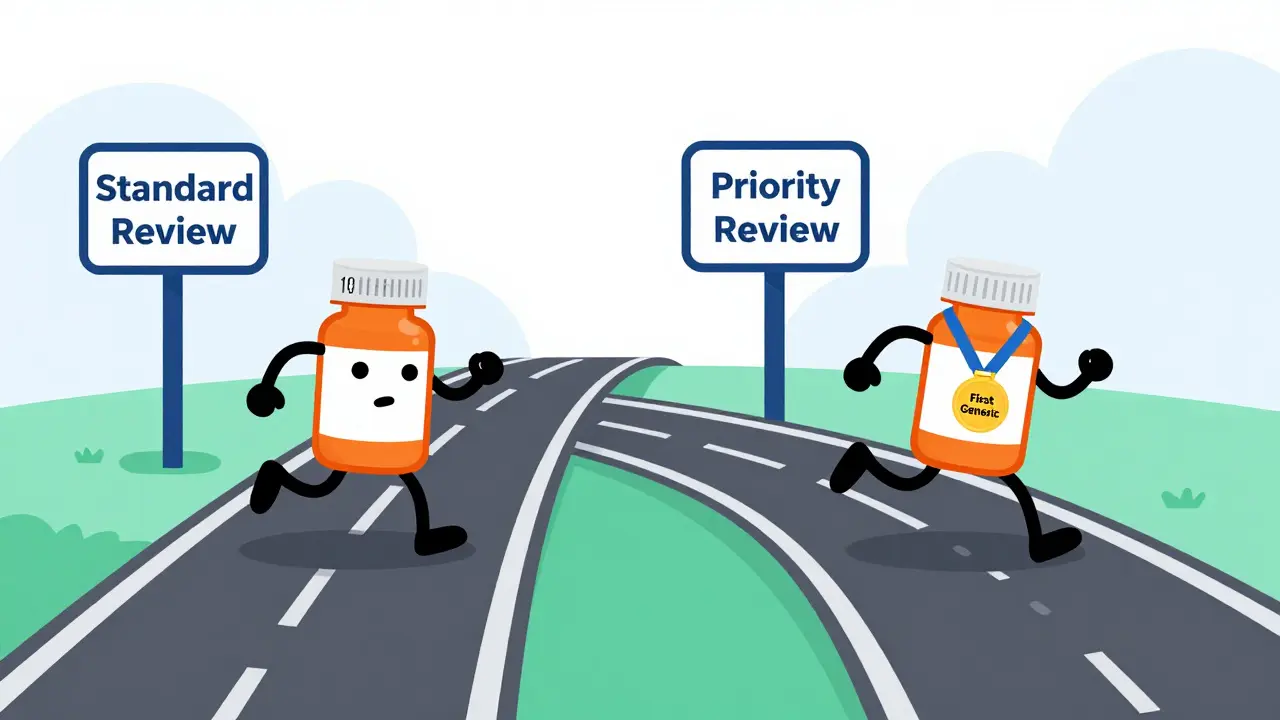
Waiting for regulatory approval is the most expensive part of bringing a generic drug to market. Every month you delay launch means millions in lost revenue and competitors gaining ground. The U.S. Food and Drug Administration (FDA) knows this, which is why they split the review process for Abbreviated New Drug Applications (ANDAs) into two distinct tracks: standard and priority.
If you are submitting an ANDA, understanding these pathways isn't just bureaucratic homework-it’s a financial strategy. Under the current Generic Drug User Fee Amendments (GDUFA III) framework, the difference between these tracks is exactly two months. That might sound small, but in the high-stakes world of pharmaceuticals, it can mean the difference between capturing 80% of the market or watching your profits evaporate to rivals who launched first.
The Two Tracks: Standard vs. Priority Timelines
The FDA’s Center for Drug Evaluation and Research (CDER), specifically the Office of Generic Drugs (OGD), manages the clock. Since October 1, 2022, when GDUFA III took effect, the agency has committed to strict Target Action Dates (TADs). These are not suggestions; they are performance goals tied to user fees paid by sponsors.
- Standard Review: The default path for most applications. The TAD is 10 months from the date the application is officially filed.
- Priority Review: An accelerated path reserved for specific categories. The TAD is 8 months from filing.
Why does this distinction exist? The FDA wants to incentivize the entry of generics that address critical public health needs. If your product helps solve a shortage or is the very first generic available for a brand-name drug with no existing competition, the agency moves faster. For everyone else, the standard 10-month clock applies.
Data from the FDA’s Fiscal Year 2022 performance report shows the system works as intended. In that year, 72.3% of standard review applications met the 10-month goal, while 83.1% of priority applications met the 8-month target. This proves that if you qualify for priority, you have a statistically higher chance of hitting the deadline on time.
Who Qualifies for Priority Review?
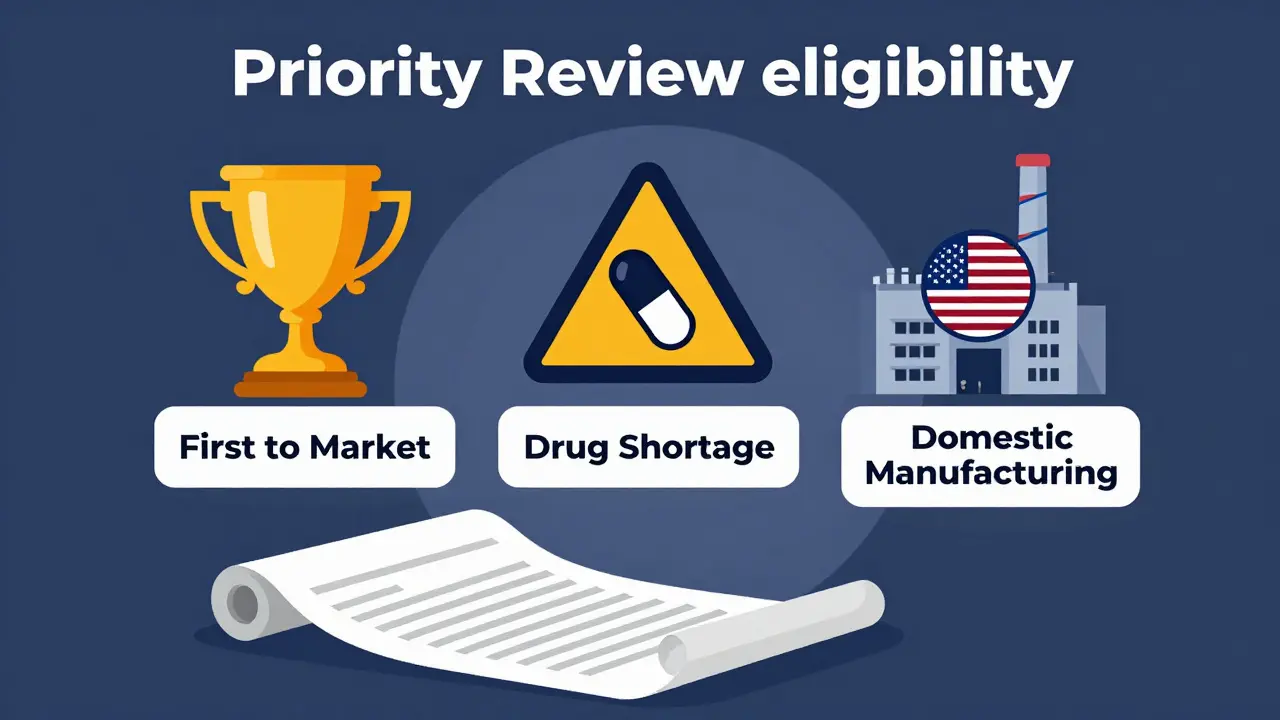
You don’t get to choose your track based on preference. Eligibility is strictly defined in the GDUFA III commitment letter and FDA guidance documents like MAPP 5240.3. Here are the three main buckets that trigger an automatic priority designation:
- First Generics: You are the first applicant to submit a substantially complete ANDA for a drug product where no other generic version currently exists. This is the most common route. If you win this race, you often earn 180-day marketing exclusivity, meaning no other competitor can launch their version for six months after you do. According to FDA data, 92.7% of first generics receive this exclusivity.
- Drugs in Shortage: Your application addresses a drug listed on the FDA’s Drug Shortages webpage. The agency prioritizes these to alleviate supply constraints quickly.
- Medically Important Advances: Your product offers a significant therapeutic improvement over existing therapies, though this category is narrower and more subjective.
To determine if you are truly "first," the FDA checks the Orange Book. This database tracks patent and exclusivity information. If another company has already filed a complete application for the same strength and dosage form, you lose first-generic status and drop back to standard review.
The New Wild Card: Domestic Manufacturing Pilot
In October 2023, FDA Commissioner Robert M. Califf announced a game-changer: the ANDA Prioritization Pilot Program. This initiative adds a fourth way to get priority review, and it’s tied directly to national security and supply chain resilience.
The pilot prioritizes applications that meet three strict criteria:
- Bioequivalence testing was conducted in the United States.
- The finished dosage form is manufactured in the U.S.
- The active pharmaceutical ingredient (API) is sourced exclusively from U.S. suppliers.
This response comes from the vulnerabilities exposed during the pandemic. Before 2020, about 80% of API manufacturing happened outside the U.S. By rewarding domestic production, the FDA aims to shift the industry landscape. Commissioner Califf stated the goal is to increase the percentage of U.S.-manufactured generic drugs from 28% to 40% within five years.
However, this path is tough. Regulatory attorney James Shehan noted that only 12.3% of ANDA sponsors currently meet all three criteria. For most global manufacturers, sourcing APIs solely from the U.S. is logistically difficult and expensive. But if you can pull it off, the 2-month acceleration could be worth the investment.
| Feature | Standard Review | Priority Review |
|---|---|---|
| Target Action Date (TAD) | 10 Months | 8 Months |
| Primary Eligibility | All non-priority ANDAs | First generics, shortages, domestic manufacturing pilot |
| Filing Fee (FY 2024) | $164,880 | $164,880 (Same fee, faster clock) |
| Market Impact | Slower entry, lower initial share | Faster entry, potential 180-day exclusivity |
| Success Rate (FY 2022) | 72.3% met timeline | 83.1% met timeline |
The Hidden Cost: Complete Response Letters
Even if you have a priority clock ticking, you aren’t guaranteed approval in 8 months. The biggest threat to your timeline is the Complete Response Letter (CRL).
A CRL means the FDA found major deficiencies in your application. When this happens, the review clock stops. You must fix the issues, resubmit, and pay a new filing fee ($164,880 in FY 2024). The clock then restarts. In FY 2022, 31.7% of original ANDAs received at least one CRL.
Where do these failures happen? Chemistry, Manufacturing, and Controls (CMC) deficiencies account for 47.2% of interruptions. This usually involves issues with how the drug is made, stored, or tested. Bioequivalence problems are another common culprit.
On average, an ANDA requires 1.7 review cycles for approval. Each cycle adds roughly 4.2 months to your total timeline. So, a "priority" application that gets a CRL in month 7 might not actually launch until month 12 or 14-worse than a standard review that goes through smoothly.
Strategic Moves: Pre-Submissions and Complex Generics
How do you avoid the CRL trap? The industry answer is engagement before submission. In 2023, 63% of generic sponsors engaged in pre-submission meetings with the FDA, up from 41% in 2020. Companies using this strategy saw their first-cycle approval rates jump from 24.1% to 38.7%.
This is especially critical for complex generics. Products like inhalers, topical creams, and modified-release formulations are harder to replicate than simple tablets. They account for 18.3% of pending ANDAs but only 9.7% of approvals due to technical difficulty.
For these products, the FDA launched the Complex Generic Drug Product Pilot Program in January 2023. This program offers early scientific advice. If you are developing a complex generic, use this resource. It can save you months of wasted effort and help ensure your application is "substantially complete" enough to qualify for priority review as a first generic.
The Financial Stakes
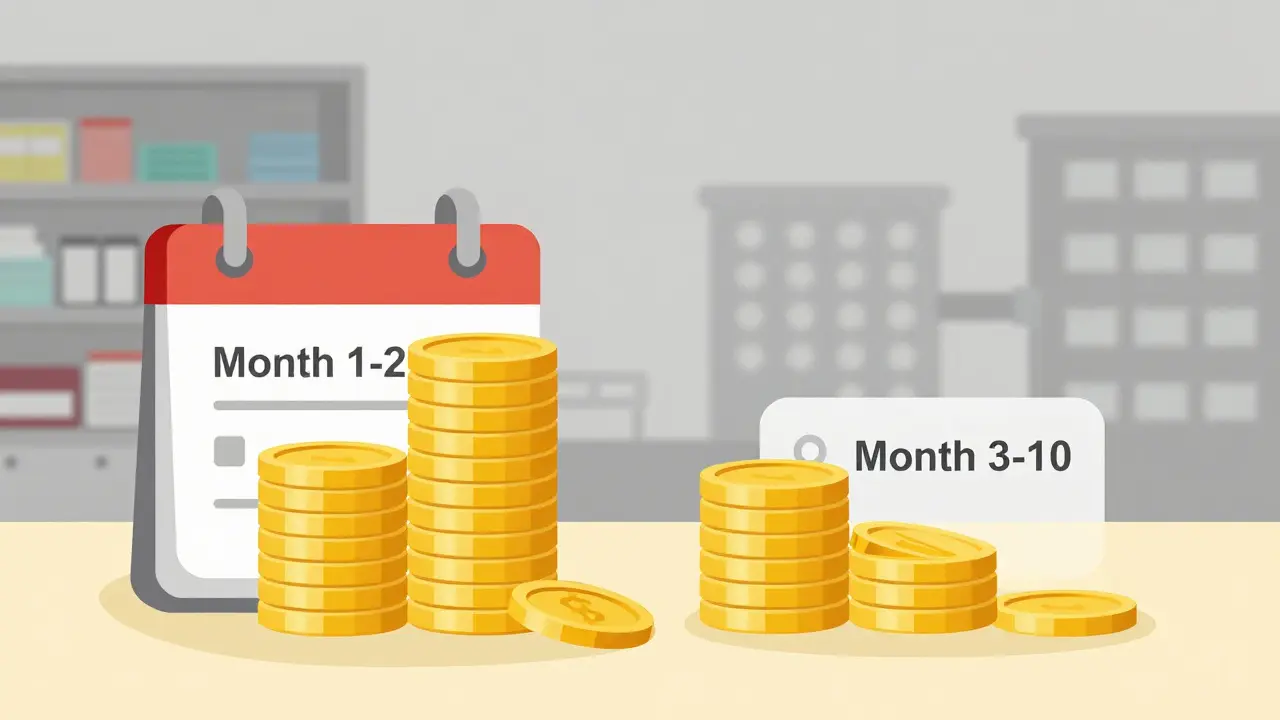
Let’s talk money. Dr. John Jenkins, former Director of CDER’s Office of New Drugs, estimates that the 2-month acceleration in priority review translates to approximately $200-$500 million in additional generic revenue for first-to-market products. Why such a huge gap?
Because generic pricing is brutal. The first generic captures nearly all the market volume initially. As soon as the second and third generics enter, prices drop precipitously. Launching two months earlier allows you to lock in contracts with pharmacy benefit managers (PBMs) and hospitals before competitors even file their applications. In a market where generics represent 88.6% of prescriptions by volume but only 15.3% by value, speed is the only leverage you have.
What’s Next for ANDA Reviews?
The landscape is shifting fast. The FDA projects a 12.5% increase in ANDA submissions for FY 2024, reaching 1,275 applications. To handle this load, the agency is implementing AI-assisted review tools. Internal pilots show these tools can reduce review times for straightforward applications by 18.7%. While this won’t replace human reviewers yet, it suggests future timelines could tighten further.
Meanwhile, the push for domestic manufacturing will continue. Contract research organizations like PPD and Covance are reporting 35% year-over-year growth in U.S.-based bioequivalence studies. Major players like Teva and Sandoz are expanding U.S. capacity. If you want priority review in the coming years, aligning your supply chain with U.S. infrastructure may become less of a "pilot" option and more of a standard requirement.
Can I request priority review for my ANDA?
No, you cannot simply request it. Priority review is automatically assigned if your application meets specific criteria, such as being the first generic for a drug without competition, addressing a drug shortage, or qualifying under the domestic manufacturing pilot program. If you do not meet these criteria, your application will undergo standard review.
What happens if the FDA sends me a Complete Response Letter (CRL)?
A CRL stops the review clock. You must address the deficiencies identified by the FDA, resubmit the application, and pay a new filing fee. Once resubmitted, the clock restarts. This can significantly delay your launch, potentially pushing a priority review beyond the standard 10-month timeline.
How much does it cost to file an ANDA in 2024?
The filing fee for an original ANDA in Fiscal Year 2024 is $164,880. This fee applies regardless of whether your application is designated for standard or priority review. Additional fees apply if you need to resubmit after a CRL.
What is the 180-day exclusivity period?
This is a regulatory protection granted to the first generic applicant who challenges a brand-name drug's patent successfully. It prevents other generic competitors from launching their versions for 180 days after the first generic hits the market. This window allows the first mover to capture maximum market share and revenue.
Does the domestic manufacturing pilot apply to all generic drugs?
It applies to any ANDA that meets the three strict criteria: U.S. bioequivalence testing, U.S. finished dosage manufacturing, and U.S.-sourced APIs. It is particularly challenging for complex generics or drugs requiring specialized excipients that are not readily available in the U.S. supply chain.