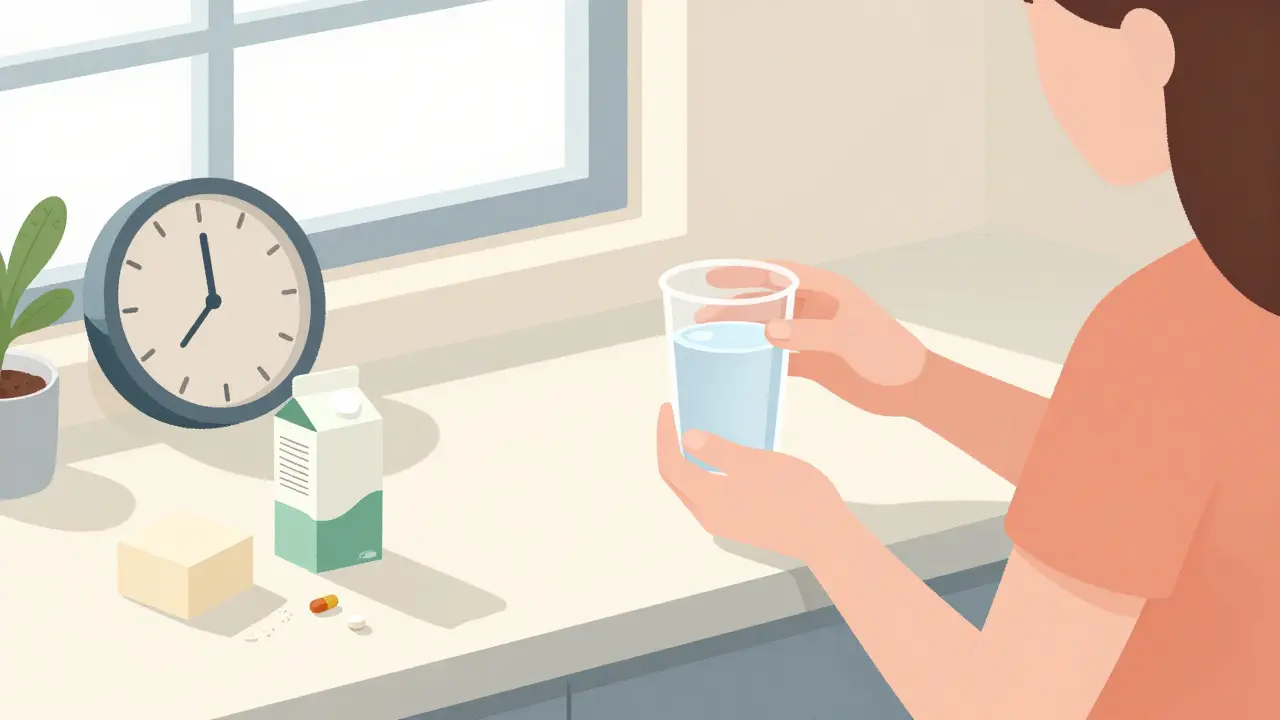
If you’re taking levothyroxine for hypothyroidism and you eat soy products like tofu, soy milk, or edamame, you might be wondering: is soy blocking my medication? The answer isn’t yes or no-it’s about timing. Soy doesn’t make your thyroid worse, but it can stop your body from absorbing your medicine properly. And that can throw your whole treatment off track.
Why Soy Interferes with Thyroid Medication
Soy contains compounds called isoflavones-mainly genistein and daidzein-that stick to levothyroxine in your gut. Think of it like Velcro: the soy proteins grab onto the hormone molecules and prevent them from being absorbed into your bloodstream. This isn’t a myth. It’s been documented since the 1960s, when babies on soy formula needed much higher doses of thyroid medicine to stay healthy.Studies show soy can reduce levothyroxine absorption by 9% to 30%, depending on how much you eat and when. One case from 2006 tracked a woman who took 200 micrograms of levothyroxine daily-twice the normal dose-because she drank soy protein shakes right after her pill. Her TSH levels stayed high until she stopped eating soy within an hour of taking her medicine.
It’s not just about soy protein powders. Whole foods like tofu, tempeh, and soy milk have the same effect. Even a single cup of soy milk consumed with your pill can cause a noticeable drop in absorption. Unlike calcium or iron supplements-which need a full 4-hour gap-soy’s interference is a bit less extreme, but still real enough to warrant caution.
How Much Soy Is Too Much?
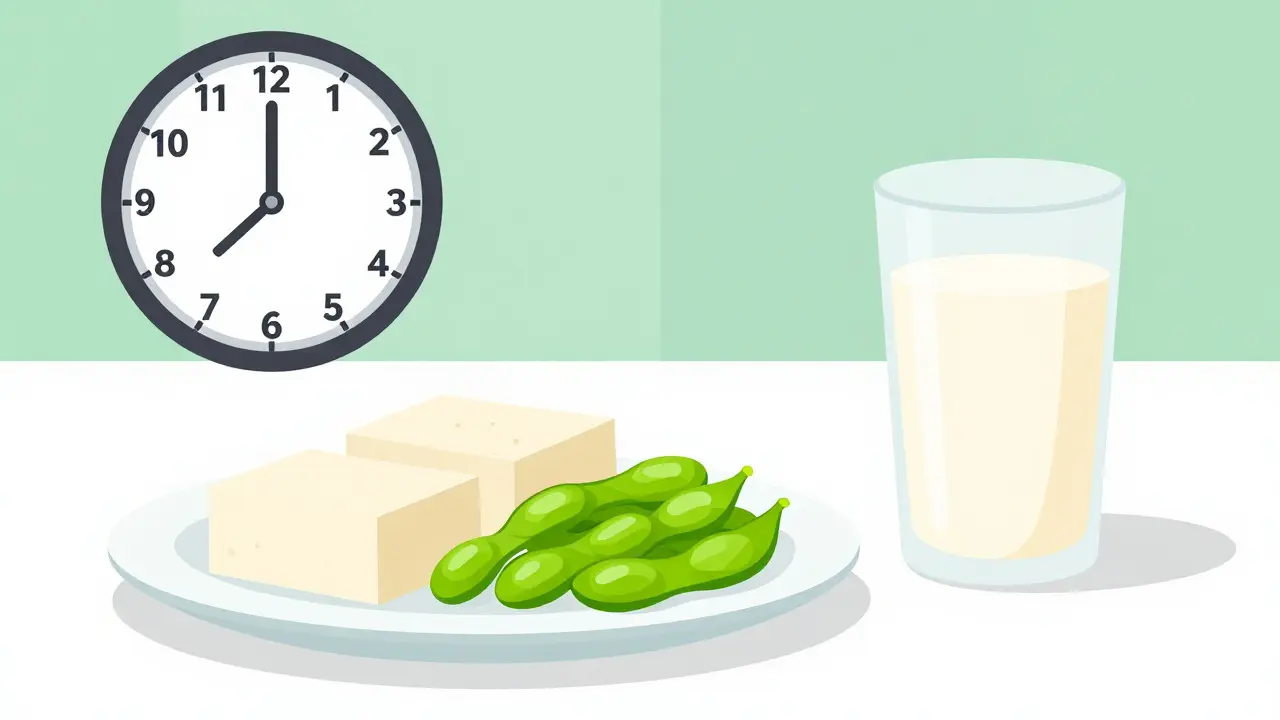
You don’t have to quit soy forever. The problem isn’t soy itself-it’s when you eat it. Research from the Mayo Clinic and Johns Hopkins shows that if you wait at least 2 to 3 hours after taking your levothyroxine before eating soy, the interference drops to almost nothing.A 2023 study in the European Thyroid Journal found that just a 2-hour gap between levothyroxine and soy milk reduced absorption interference to levels so small they didn’t even show up in TSH tests. That’s why many doctors now say 2 hours is enough for most adults. But if you’re a child, pregnant, or just starting treatment, stick with 3 to 4 hours. Your body is still learning how to handle the hormone, and you can’t afford any gaps in absorption.
Here’s what the data says about different soy forms:
- Whole soy foods (tofu, edamame, soy milk): Need 3-4 hours separation
- Soy protein shakes or powders: Highest risk-wait at least 4 hours
- Soy isoflavone supplements: Less impact than whole soy, but still wait 2-3 hours
One key thing to remember: it’s not the amount of soy that matters most-it’s the timing. Someone who eats a small amount of tofu with dinner and takes their pill at 7 a.m. might have no issues. Someone who drinks soy milk with breakfast right after their pill could see their TSH spike.
What Happens If You Ignore the Timing?
If you regularly eat soy within an hour of taking your thyroid medicine, your body won’t get the full dose. That means your thyroid hormone levels stay low, even if you’re taking the right amount of pills. Your pituitary gland notices this and pumps out more TSH to try to wake up your thyroid. That’s why your TSH levels creep up.One Reddit user, HypoWarrior42, shared that after switching to daily soy milk with breakfast, their TSH jumped from 1.8 to 5.2 in just three months. Their doctor increased their dose from 75 mcg to 100 mcg. But another user, SoyLoverHypo, said they’ve taken Synthroid with soy milk for five years with perfect TSH levels-because they take their pill at bedtime, and soy is only in their lunch and dinner.
This isn’t random. It’s about consistency. If you take your pill in the morning and eat soy at breakfast, you’re fighting your own treatment. But if you take it at night, 2-3 hours after your last meal (and soy), you’re giving your body the best shot at absorbing every microgram.
Best Practices: When and How to Take Your Medicine
There are two proven ways to avoid soy interference without giving up your favorite foods:- Morning routine: Take levothyroxine on an empty stomach with a full glass of water. Wait at least 60 minutes before eating or drinking anything else. Then wait another 2-4 hours before eating soy. That means no soy yogurt at breakfast, no soy latte, no tofu scramble. Save your soy for lunch or dinner.
- Bedtime routine: Take your pill at least 3-4 hours after your last meal. This works well if you eat soy at breakfast or lunch. Many people find this easier because they don’t have to plan around morning meals. Just make sure you’re not eating right before bed-soy in your evening snack still counts.
Don’t take your pill with coffee, calcium, iron, or fiber supplements. Those interfere too. Coffee cuts absorption by about 20%. Calcium and iron? Up to 36%. Soy is in the middle-less than calcium, but worse than coffee.
Here’s a simple daily schedule that works for most people:
- 6:30 a.m.: Take levothyroxine with water
- 7:30 a.m.: Breakfast (no soy, no coffee, no dairy)
- 12:00 p.m.: Lunch (tofu, soy milk, edamame-now it’s safe)
- 6:00 p.m.: Dinner (more soy if you want)
- 10:00 p.m.: Take levothyroxine (if doing bedtime dosing)
Stick to one method. Don’t switch back and forth. Consistency is what keeps your TSH stable.
Who Needs to Be Extra Careful?
Not everyone reacts the same way. Some people absorb levothyroxine fine even with soy. Others see big changes with just one soy latte.You’re at higher risk if you:
- Have been on levothyroxine less than 3 months
- Are under 18 or over 65
- Have subclinical hypothyroidism (TSH over 4.5)
- Follow a vegan or vegetarian diet and eat soy daily
- Are pregnant or planning to be
Studies show that soy’s effect on TSH is strongest in people with already borderline thyroid function. If your TSH is creeping up and you can’t figure out why, check your soy intake. A simple change in timing can bring your levels back into range without changing your dose.
What About Other Foods and Supplements?
Soy isn’t the only troublemaker. Here’s a quick ranking of common interferers, from worst to least bad:- Calcium supplements (25-36% reduction)
- Iron supplements (20-30% reduction)
- Soy products (9-30% reduction)
- High-fiber foods (like psyllium or bran-up to 20% reduction)
- Coffee (about 20% reduction)
Iron and calcium need a 4-hour gap. Coffee? Wait 60 minutes. Soy? 2-3 hours. Fiber? Wait 2-3 hours too. If you’re taking multiple supplements, space them out. Don’t take your calcium pill and soy milk at the same time as your thyroid med. That’s a triple hit.
Pro tip: If you take a multivitamin with iron or calcium, take it at lunch or dinner-not with your morning pill.

What Do Experts Really Say?
There’s some disagreement among doctors, but the core advice is the same:- The American Thyroid Association says 2-3 hours is enough.
- Mayo Clinic updated their guidelines in 2023 to say 2 hours works for most adults.
- Dr. David Heber (UCLA) recommends 4 hours for safety.
- Dr. Mario Skugor (Cleveland Clinic) says most people are fine with 2-3 hours, but he’s seen cases where 50 mcg dose increases were needed because of daily soy milk.
The bottom line? Don’t panic. You don’t have to give up soy. But you do need to plan around it. If your TSH is stable and you eat soy regularly, you’re probably fine. If your levels are rising and you eat soy close to your pill, timing is your fix.
Real-World Tips for Daily Life
Here’s how real people make this work:- Switch to almond or oat milk for breakfast-it’s easier than waiting 4 hours.
- Use soy in lunch and dinner-it’s the safest window.
- Set phone alarms-one for taking your pill, one for eating soy.
- Keep a food and TSH journal-note when you eat soy and how your levels change.
- Ask your pharmacist-they can check if your pill form is affected by soy (some brands are more sensitive than others).
Many endocrinologists now give patients printed timing charts. The Thyroid Patient Advocacy group has a free one online. Print it. Tape it to your fridge.
Final Takeaway
Soy doesn’t destroy your thyroid medication. But if you eat it too close to your pill, it can quietly sabotage your treatment. The fix isn’t drastic. It’s simple: wait at least 2 hours after taking levothyroxine before eating soy. For extra safety, especially if you’re new to treatment or have unstable levels, go for 3-4 hours.You don’t need to give up tofu. You just need to eat it at the right time. And that small change can make all the difference between feeling tired and feeling like yourself again.





Bro, I took my levothyroxine with soy milk for three years and my TSH was always perfect. You people act like soy is poison. It’s not. If your body can’t handle a little tofu, maybe your endo gave you the wrong dose.
Stop fear-mongering. I’m 42, vegan, and I eat edamame for lunch like it’s my job. My labs? Clean. Stop making this harder than it is.
It is imperative to underscore that the isoflavone-mediated inhibition of levothyroxine absorption is a well-documented pharmacokinetic interaction, substantiated by multiple randomized controlled trials and meta-analyses published in peer-reviewed endocrinological journals.
Failure to observe a temporal separation of at least 180 minutes between ingestion of soy-derived phytoestrogens and thyroxine administration constitutes a clinically significant deviation from evidence-based therapeutic protocols.
It is not a matter of personal preference-it is a matter of bioavailability.
Just wanna say-this post saved my life. I was taking my pill at 7am and having soy yogurt at 7:15. My TSH was stuck at 6.8 for six months. I started waiting 2 hours before soy, and three months later? TSH at 2.1. I actually have energy now.
It’s not about giving up soy. It’s about giving your body a chance to work.
Thank you for the real talk.
I switched to bedtime dosing and now I eat soy for breakfast and lunch without thinking about it. No alarms. No stress. My TSH has been stable for two years.
Also I drink oat milk now because it’s cheaper and tastes better anyway.
Just saying.
Respectfully, this is a very thoughtful and scientifically grounded exposition on the interaction between dietary soy and levothyroxine pharmacokinetics.
It is commendable that the author has taken the time to delineate practical, patient-centered recommendations grounded in clinical evidence.
I shall share this with my colleagues in Lagos who manage thyroid disorders in resource-limited settings.
Thank you for clarity amid the noise.
So I take my pill at 10pm and eat soy at 7am. Is that okay?
Also I forgot to take my pill yesterday and now I’m crying over my tofu bowl
oops
Wow. So soy is the new gluten. I can’t believe we’ve been lied to all these years.
Next you’ll tell me oxygen interferes with my thyroid med if I breathe within 4 hours of taking it.
Also I’m 62, vegan, and my TSH is 0.8. So maybe the real problem is people who think their body is a chemistry set.
Also I typed this on my phone and my autocorrect changed ‘thyroid’ to ‘thorium’ so I’m just gonna go with that.
I’m from Japan, where soy is in everything-from miso to natto. I’ve been on levothyroxine for 15 years. I take it at 6am, wait until 8:30am for breakfast with tofu, and my TSH has never budged.
Everyone’s body is different. Some people are sensitive. Others aren’t.
Don’t panic. Just track your labs. If your numbers are good, you’re probably fine.
And if they’re not? Try waiting 2 hours. It’s free advice that might help.
Interesting. I’ve been eating soy daily since I started Synthroid. My TSH was 5.1 last year. I moved my soy to after lunch and now it’s 2.4. Took 3 months.
So yeah. Timing matters.
Thanks for the data.
This is all a Big Pharma scam to sell you more pills.
Soy has been eaten with thyroid meds for centuries. The only reason your TSH is high is because your doctor doesn’t know what they’re doing.
Also, levothyroxine is just synthetic cow hormone. Your body doesn’t need it. Eat kelp and meditate.
And don’t believe anything you read on the internet unless it’s written by a 17th-century herbalist.
OMG I just realized I’ve been eating soy yogurt with my pill for 2 years 😭
Thank you for this post. I’m switching to bedtime dosing tomorrow. And I’m getting an oat milk latte for breakfast. 🙏
Also if anyone needs a printable timing chart, I made one. DM me. I’ll send it 😊