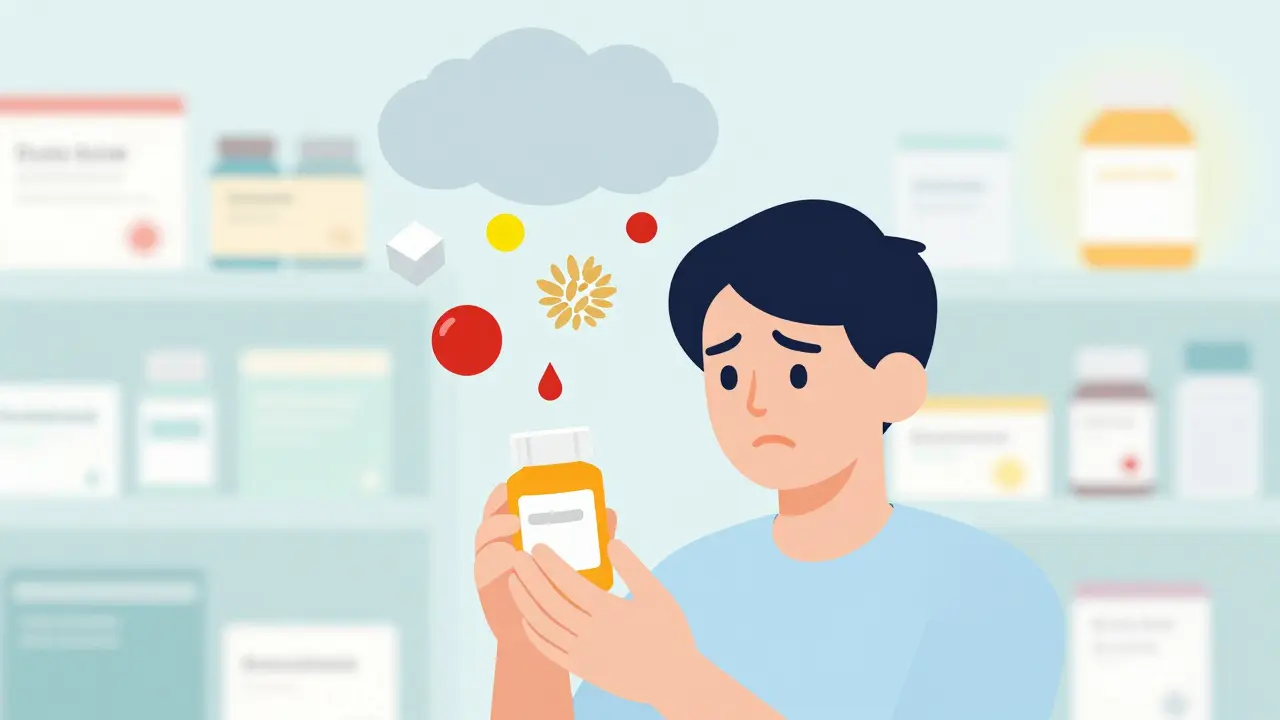
Most people assume that a generic pill is just a cheaper version of the brand-name drug-same active ingredient, same effect. And for the vast majority, that’s true. But when your body reacts differently after a switch-new headaches, weird rashes, or sudden anxiety-it’s not just in your head. Something real is happening. You’re not imagining it. And you might need to act fast.
Why Your Body Reacts Differently to Generic Drugs
Generic drugs are required to have the same active ingredient as the brand-name version. That part is non-negotiable. But everything else? That’s where things get messy. The fillers, dyes, coatings, and preservatives-called excipients-are not regulated to be identical. And for some people, those tiny differences make a huge difference. Take levothyroxine, the common thyroid medication. One manufacturer uses lactose as a filler. Another uses cornstarch. If you’re lactose intolerant, even a small amount can throw off your thyroid levels, making you feel tired, shaky, or heart-racing-even though the active ingredient is exactly the same. A 2023 GoodRx analysis found that 23.7% of patients switching to generic levothyroxine reported new or worse symptoms. That’s more than one in four. The same goes for psychiatric meds. A Reddit user named u/ADHDstruggles reported that generic Adderall from one company gave him stomach cramps and headaches, while another generic version worked fine. The brand-name version? No issues at all. Why? Different binders. Different coatings. Different manufacturing environments. Even the size of the particles in the pill can change how fast the drug is absorbed-and that matters, especially for drugs with a narrow therapeutic index.What Is a Narrow Therapeutic Index? (And Why It Matters)
Some drugs don’t have a lot of room for error. A tiny change in blood levels can mean the difference between treatment and danger. These are called narrow therapeutic index (NTID) drugs. The FDA lists 18 of them. Among the most common:- Warfarin (Coumadin) - a blood thinner
- Levothyroxine (Synthroid) - for thyroid function
- Phenytoin (Dilantin) - for seizures
- Lithium - for bipolar disorder
Excipients: The Hidden Culprits
You won’t find excipients listed on the pill bottle in plain language. But they’re there. And they’re not harmless. - Gluten - found in some generic versions of seizure meds and antidepressants. Can trigger gut damage in celiac patients, even if they’ve never had symptoms before. - Lactose - used as a filler in hundreds of generics. Can cause bloating, diarrhea, or even mimic hypothyroid symptoms. - Artificial dyes - red 40, yellow 5, blue 1. Linked to headaches, rashes, and behavioral changes in kids. Found in liquid versions of ADHD meds and children’s antibiotics. - Benzalkonium chloride (BAK) - a preservative in generic eye drops. The branded version, Travatan Z, uses a different preservative. Patients switching to the generic often report burning, redness, and vision blur. One ophthalmology study found 68% of patients with prior sensitivity improved after switching back to the brand. - Saccharin and peppermint - used in chewable or flavored tablets. Can irritate the gut lining, causing nausea or acid reflux. These aren’t rare. They’re standard. And if you’ve got a sensitivity, your body knows.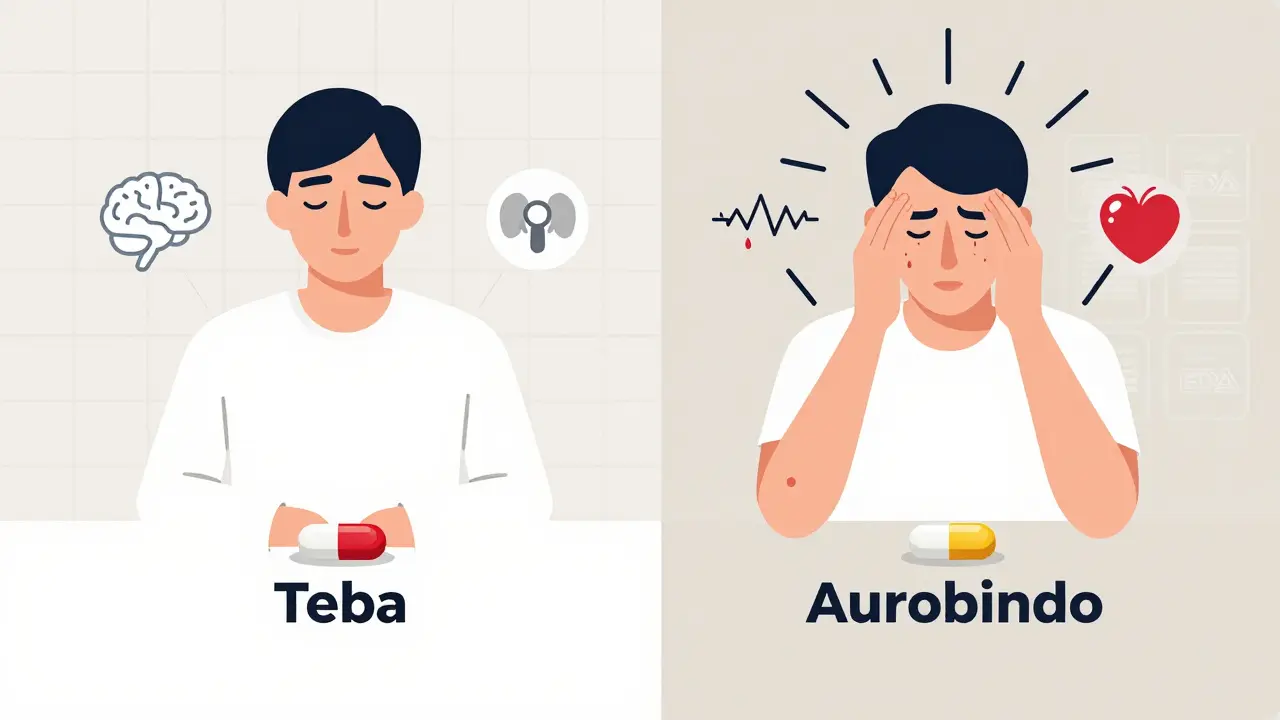
When to Seek Help-Red Flags You Can’t Ignore
Not every new symptom means you need to rush to the ER. But some signs are non-negotiable. If you experience any of these within 1-2 weeks of switching to a generic, contact your doctor immediately:- Severe skin reaction - rash that spreads, blisters, peeling skin, or sores in your mouth or eyes. This could be Stevens-Johnson Syndrome, a rare but life-threatening reaction linked to lamotrigine, allopurinol, and some antibiotics.
- Priapism - a painful erection lasting more than 4 hours. Seen with trazodone, bupropion, and some ED meds. Requires emergency treatment to prevent permanent damage.
- Unexplained bleeding or bruising - especially if you’re on warfarin or another blood thinner. Check your gums, stools, or urine.
- Sudden confusion, seizures, or loss of coordination - could mean your seizure meds aren’t being absorbed properly.
- Heart palpitations, chest pain, or dizziness - especially if you’re on blood pressure or thyroid meds.
- Severe nausea or vomiting lasting more than 48 hours - could signal a reaction to a new filler or coating.
What to Do If You Suspect a Generic Is Causing Problems
1. Don’t stop the medication cold. Stopping thyroid meds, seizure drugs, or blood thinners suddenly can be dangerous. Talk to your provider first. 2. Check the manufacturer. Look at the pill. It’s often printed on the tablet. Or check the pharmacy label. Some generics are labeled with the manufacturer’s name (like “Aurobindo” or “Teva”). Keep a note of which one works and which one doesn’t. 3. Ask your pharmacist to hold the same manufacturer. Pharmacists can often fill your prescription with the same generic brand if you request it. You might have to pay a little more, but it’s worth it if your body responds better. 4. Ask your doctor to write “Dispense as Written” or “Do Not Substitute” on the prescription. This legally prevents the pharmacy from switching your generic without your doctor’s approval. 5. Report it to the FDA. Use MedWatch, the FDA’s online system for reporting adverse events. Include the drug name, manufacturer, lot number (found on the bottle), and your symptoms. These reports help the FDA spot dangerous patterns.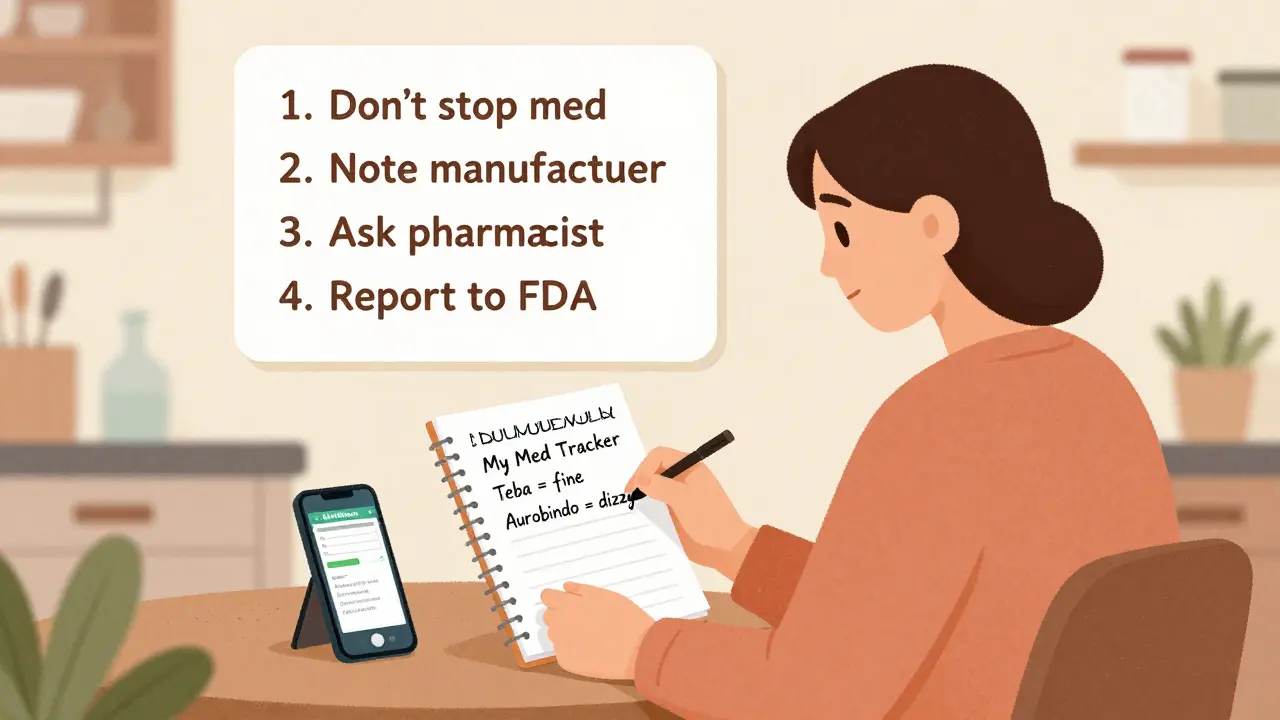
The Bigger Picture: Why This Keeps Happening
Generic drugs save the U.S. healthcare system over $1.6 trillion a year. That’s huge. But the system is built on volume, not individualization. The top five generic manufacturers now control nearly 44% of the U.S. market. That means fewer options when one version causes problems. Over 70% of the active ingredients in generics are made overseas-in India and China. The FDA inspects only a fraction of these facilities. A 2022 Government Accountability Office report found that 18% of foreign plants had delayed or limited inspections. That’s not a guarantee of safety. It’s a gamble. And here’s the kicker: the FDA’s own data shows that 1,842 adverse events between 2020 and 2023 were directly tied to switching generics. The most common? Gastrointestinal issues, neurological symptoms, and skin reactions. New legislation introduced in February 2024-the Generic Drug Safety Act-would require manufacturers to notify prescribers and pharmacists whenever they change excipients. That’s a step forward. But right now, you’re the first line of defense.What You Can Do Today
- If you’ve been on a generic for months and feel fine? Keep going. Most people are fine. - If you switched recently and feel off? Track your symptoms. Note the date, the manufacturer, and what changed. - If you’re on a high-risk drug (thyroid, seizure, blood thinner, psychiatric), ask your doctor if you should stick with one manufacturer. - Keep a small note in your phone: “My thyroid med works best with Teva. Avoid Aurobindo.” - Don’t be afraid to ask your pharmacist: “Is this the same manufacturer as last time?” Your body knows what it likes. Trust it. And if something feels wrong after a switch? It probably is.Can generic drugs really cause different side effects than brand-name drugs?
Yes. While the active ingredient is identical, the inactive ingredients-like fillers, dyes, and preservatives-can vary between manufacturers. These differences can trigger reactions in sensitive individuals, especially with drugs that have a narrow therapeutic index, like warfarin or levothyroxine. Studies show 8-15% of patients report new or worsening side effects after switching to a generic.
Which generic medications are most likely to cause problems?
Drugs with a narrow therapeutic index carry the highest risk: thyroid meds (levothyroxine), blood thinners (warfarin), seizure meds (phenytoin, lamotrigine), psychiatric drugs (lithium, some antidepressants), and certain heart medications. Also, complex formulations like eye drops, inhalers, and transdermal patches are more likely to have formulation differences that affect absorption.
What should I do if I think my generic drug is making me sick?
Don’t stop taking it without talking to your doctor. Write down your symptoms, when they started, and which manufacturer made your pill. Call your doctor or pharmacist. Ask if you can switch back to the previous version or request a different generic. You can also report the issue to the FDA through MedWatch.
Can I ask my doctor to prescribe only one brand of generic?
Yes. Your doctor can write “Dispense as Written” or “Do Not Substitute” on your prescription. This legally prevents the pharmacy from switching your generic without your doctor’s approval. Some pharmacies will honor this request even without it written-just ask.
Are generic drugs from India or China less safe?
Not necessarily-but oversight is inconsistent. Over 70% of active ingredients in U.S. generics come from India and China. The FDA inspects only a small percentage of these facilities each year. While many are compliant, delays and limited inspections mean quality control can vary. That’s why tracking the manufacturer and reporting side effects matters.


Okay, I need to say this out loud: I switched my levothyroxine to a generic last year and spent three months feeling like a zombie with a side of panic attacks. No one believed me until I tracked the manufacturer-Teva worked, Aurobindo turned me into a trembling mess. I even called the pharmacy and demanded the same batch every time. They thought I was crazy. Turns out, I was just smart. Your body isn't broken. The pill is.
And yes, the dyes? Real. My niece broke out in hives from a generic amoxicillin with Red 40. No one even thought to ask if she was sensitive to food dyes. Now we check every bottle like it's a bomb squad inspection. Don't let them gaslight you into thinking it's 'all in your head.' It's not.
Also, if you're on warfarin? DO NOT SWAP BRANDS. I saw a guy in the ER last month because his INR went from 2.1 to 6.8 after a 'routine' switch. He almost bled out. This isn't theoretical. It's life-or-death math.
I’m from India, and I work in pharma logistics. Let me tell you something: the same generic pill made in Hyderabad can be sold in the US under 3 different brand names, and each batch might come from a different factory floor. Quality control? Sometimes it’s a joke. I’ve seen labs where they reuse the same vials for 3 different drugs because ‘they’re all powders, right?’
My cousin took a generic seizure med from a company that outsourced their fillers to a factory that also made laundry detergent. She had seizures every Tuesday. Turns out, the binder was contaminated with surfactant. No one knew. No one checked. We had to fly her to the US to get the same drug she was on before.
Stop trusting the label. Start tracking the code. Write it down. Your life depends on it.
So let me get this straight: we pay $400 for a brand-name pill that’s chemically identical to a $4 generic… but the generic gives you anxiety because someone used cornstarch instead of lactose? And we’re supposed to be grateful for ‘savings’?
Bro. We’re being scammed by a system that treats human bodies like interchangeable parts. I’ve had to pay out-of-pocket for the same thyroid med because my insurance ‘approved’ the one that made me feel like I was being slowly suffocated by my own organs.
Also, if your pharmacist says ‘it’s the same thing’-smile, nod, then walk out and call your doctor. 🤡💊
It’s not the excipients. It’s the placebo effect amplified by fear of change. People get anxious when they switch pills. Their bodies react to anxiety. They blame the pill. It’s confirmation bias with a pharmacy receipt.
The FDA approves generics. The data is clear. If you’re having side effects, maybe it’s not the drug. Maybe it’s you.
Also, warfarin? You’re supposed to get blood drawn weekly. That’s your job, not the manufacturer’s.
Stop blaming capitalism for your biology.
I just want to say, I appreciate this post. Really. I’ve been on levothyroxine for 12 years, and I switched generics twice and felt awful both times. I didn’t know why. Now I do.
My pharmacist actually helped me out when I asked if they could keep me on the same maker. She wrote down the lot number for me. I keep it in my wallet. I don’t know why more people don’t do this.
It’s not about being difficult. It’s about being informed. And if your doctor doesn’t get it, find one who does. You deserve to feel okay.
Also, thank you for mentioning the FDA reporting thing. I’m going to do that today.
OMG YES. I’m a mom of two with ADHD. My son was on brand-name Adderall for years-no issues. Then insurance switched him to a generic and he went from focused to screaming at the wall for 48 hours. We thought it was autism regression. Turns out? The coating was different. It released too fast.
We switched back to the brand and he’s back to drawing space rockets and doing his homework. I cried. I was so mad.
Now I keep a note in my phone: ‘DO NOT SUBSTITUE ADDERALL.’ I print it and hand it to the pharmacist. They roll their eyes. I don’t care.
Also, if your kid’s on liquid ADHD meds? Check for dyes. Red 40 is a nightmare. My daughter got migraines from blue 1. No one told me. Now I read every tiny print like it’s a treasure map. 🧠💙
Look, I get it. You’re scared. You had a bad experience. But let’s not turn this into a horror movie about Big Pharma. The reality is, 95% of people switch generics and feel zero difference. The 5% who don’t? They’re the ones who scream loudest on Reddit. That’s not data-that’s anecdotal noise.
And let’s talk about the real issue: you’re paying $400 for a brand-name drug because you’re too lazy to learn how to read a pill imprint. The manufacturer code is printed on the tablet. It’s not a secret. You just don’t care enough to look.
Also, the FDA inspects foreign plants. Yes, not all. But enough. The idea that Indian factories are just dumping poison into your pills? That’s a 2008 Fox News headline. Not science.
And for the love of God, stop calling every headache a ‘reaction.’ You drank coffee. You slept wrong. You’re stressed. Stop blaming the pill for your life choices.
Also, why are you all so obsessed with dyes? Are we going to start banning sugar next? Next thing you know, people will be suing aspirin because it has cornstarch and their cousin’s dog has a corn allergy.
Just take the damn pill. Your body will adapt. Or don’t. But stop making this a crusade.
You people are disgusting. You’re so obsessed with your ‘sensitivities’ that you’re undermining public health. Generics exist so the poor can live. But you? You want your expensive brand-name pills because you think you’re special. You’re not. You’re just selfish.
And now you’re telling pharmacists to refuse substitutions? That’s not healthcare. That’s entitlement wrapped in a prescription bottle.
Stop pretending your body is some sacred temple. It’s not. It’s a biological machine. And machines don’t get to pick their fuel.
Also, reporting to the FDA? That’s a waste of time. You’re not helping anyone. You’re just making the system slower for people who actually need help.
Take the generic. Be grateful. And stop acting like you’re the first person in history to feel weird after a pill change.
It is a matter of profound concern that regulatory frameworks in the United States permit the substitution of pharmaceutical excipients without mandatory disclosure or prescriber notification. The absence of harmonized standards for non-active ingredients constitutes a systemic failure of pharmacovigilance. In India, such practices are subject to stricter documentation under the Drugs and Cosmetics Act, 1940. The current U.S. model is not merely inadequate-it is ethically indefensible.
Furthermore, the concentration of manufacturing in two nations with inconsistent oversight protocols introduces unacceptable risk vectors. The probability of substandard intermediates entering the supply chain is statistically significant. One must question the integrity of the entire pharmacopeia.
It is imperative that the FDA institute mandatory excipient traceability at the batch level. Until then, the patient is not a stakeholder. The patient is an experimental subject.
I don’t care what you say. I switched to generic and I felt fine. You’re all just drama queens. I’ve been on the same generic for 10 years. No problems. Stop making this a thing.
Also, why do you all think you’re so special? My grandma took generics her whole life and never complained. You’re just weak.
And yeah, I know what you’re gonna say-‘but my body is different!’ Nah. You’re just lazy. Take the pill. Shut up. Move on.
Also, I’m not reporting anything to the FDA. I got better things to do. Like watch Netflix.
And stop asking pharmacists for the same brand. They hate you. I’ve seen them roll their eyes. Just take what they give you. It’s fine.
Also, I’m not writing anything down. My memory is fine. I’m not a baby.