HIV Medication & Antibiotic Interaction Checker
Check for Dangerous Interactions
Important: This tool provides general guidance based on common interactions. Always consult your HIV specialist or pharmacist before changing medications.
When you’re living with HIV, taking your meds every day isn’t just routine-it’s life-saving. But what happens when you need an antibiotic for a bad sinus infection, pneumonia, or a stubborn UTI? Suddenly, your carefully balanced treatment plan can get thrown off track. That’s because HIV medications and antibiotics don’t always play nice together. Some combinations can make your HIV drugs less effective. Others can turn safe antibiotics into dangerous ones. And many times, you won’t even know it’s happening until it’s too late.
Why This Isn’t Just a Minor Concern
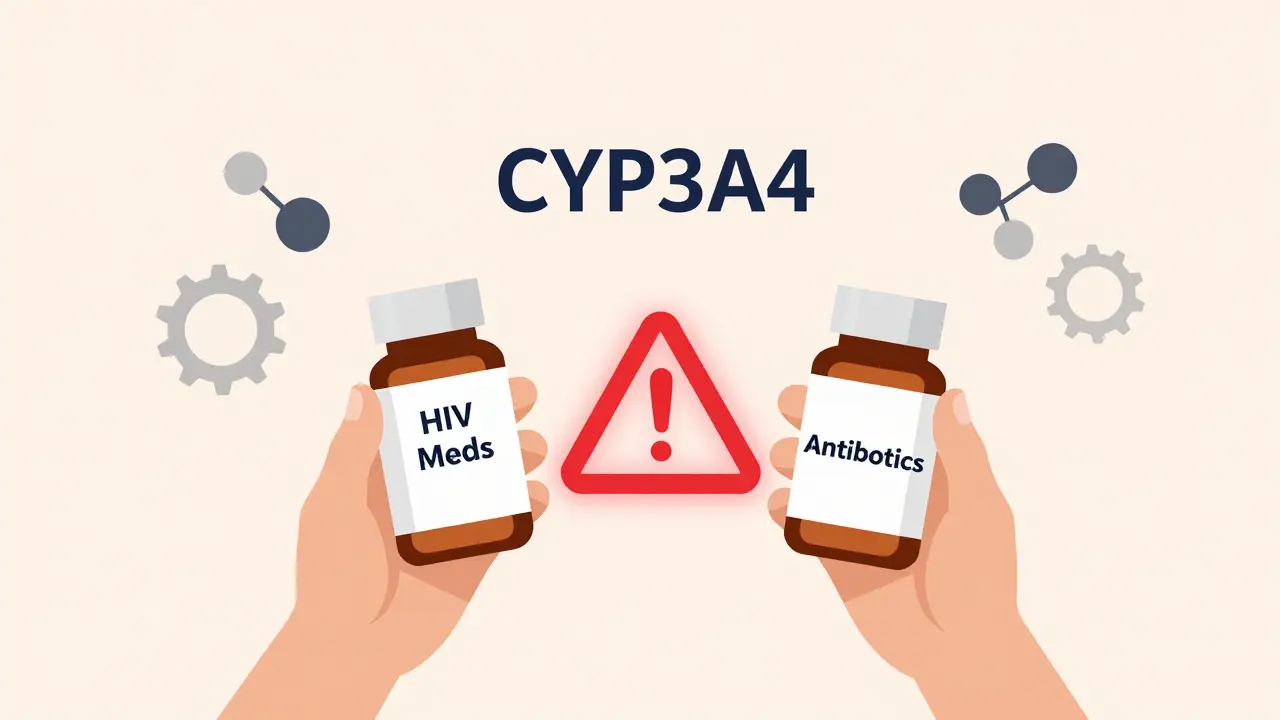
About 68% of people with HIV get at least one antibiotic every year. Respiratory infections, urinary tract infections, and skin infections are common. But here’s the catch: the same liver enzymes that break down your HIV meds also break down most antibiotics. That’s where the trouble starts. The main player in this game is CYP3A4, a liver enzyme that handles roughly half of all prescription drugs. Many HIV medications-especially protease inhibitors like darunavir and boosted regimens with ritonavir or cobicistat-rely on this enzyme. So do common antibiotics like clarithromycin, erythromycin, and rifampin. When both are taken together, they can either block or speed up how fast the other is processed. The result? Either too much drug in your system (risking toxicity) or too little (risking treatment failure). A 2021 study looked at 114 essential medicines in Thailand and found 292 possible interactions between antiretrovirals and antimicrobials. The Liverpool HIV Drug Interactions database, the most trusted source for this info, flagged 128 of those as major or severe. That’s not a small number. That’s a real risk.Which HIV Meds Are Most Likely to Cause Problems?
Not all HIV drugs are created equal when it comes to interactions. Some barely touch the CYP system at all. Others? They’re like chemical fireworks. High-risk HIV meds:- Boosted protease inhibitors (ritonavir, cobicistat, darunavir, atazanavir)
- Some NNRTIs (efavirenz, nevirapine, rilpivirine)
- Maraviroc (a CCR5 blocker)
- Integrase inhibitors (dolutegravir, bictegravir, islatravir)
- NRTIs (tenofovir, emtricitabine, abacavir)
- Fusion inhibitors (enfuvirtide-no longer available in the U.S.)
- Lenacapavir (new long-acting injectable)
Antibiotics That Can Be Dangerous with HIV Meds
Here are some common antibiotics that can cause serious problems:- Rifampin (used for TB): This one is a major red flag. It’s a strong CYP3A4 inducer. It can slash your HIV drug levels by up to 80%. It’s contraindicated with boosted PIs and most NNRTIs. If you have TB and HIV, rifabutin is the safer alternative-but even that needs dose adjustments.
- Clarithromycin (for lung infections): When taken with boosted darunavir, clarithromycin levels jump by 82%. That raises your risk of heart rhythm problems, nausea, and liver damage. Azithromycin is the go-to replacement here-it doesn’t get metabolized by CYP3A4.
- Fluoroquinolones (ciprofloxacin, levofloxacin): These can pile up with tenofovir disoproxil fumarate (TDF), increasing the chance of kidney injury by more than three times. If you’re on TDF and need a fluoroquinolone, your doctor should monitor your kidney function closely.
- Voriconazole (for fungal infections): This antifungal can cause dangerous spikes in levels when taken with cobicistat. The fix? Cut the voriconazole dose in half. Posaconazole is often a better choice because it doesn’t interact as badly.
What to Do When You Need an Antibiotic
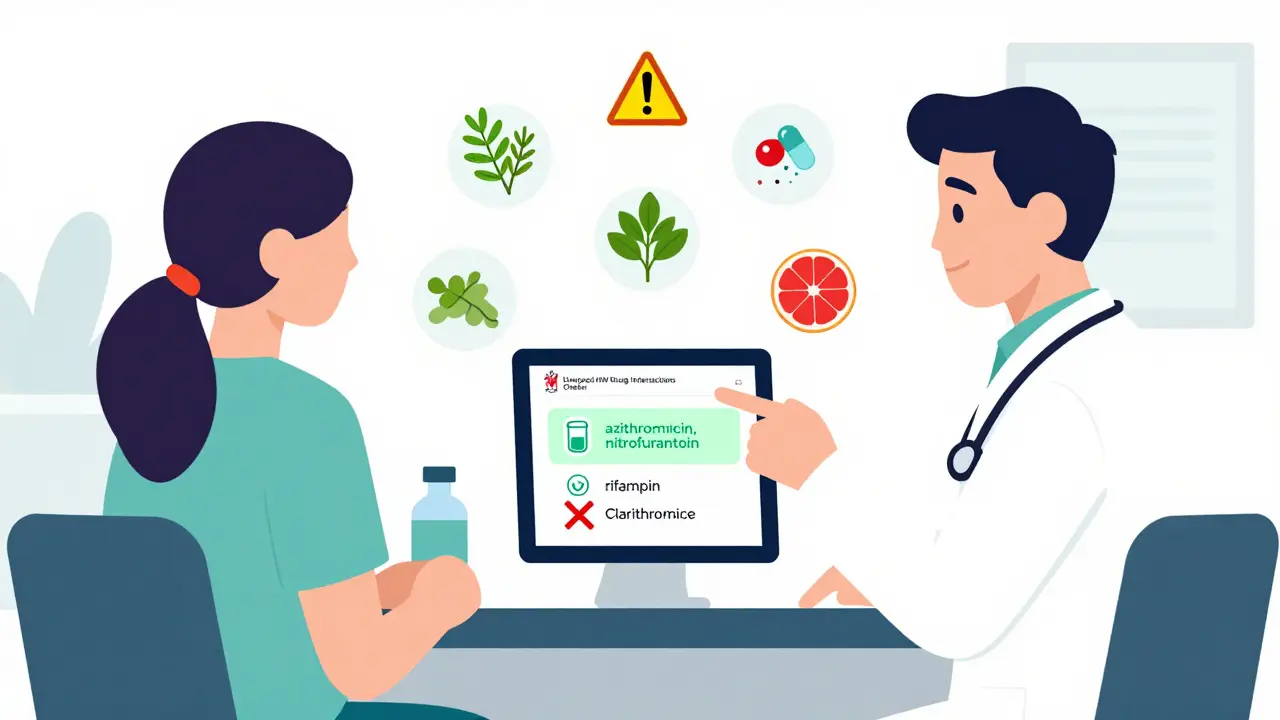
Don’t panic. But do take action. Step 1: Always tell your doctor you’re on HIV meds. Even if you think it’s just a simple infection. Many doctors don’t realize how complex these interactions are. Step 2: Use the Liverpool HIV Drug Interactions Checker. It’s free, updated monthly, and used by clinics worldwide. Type in your HIV meds and the antibiotic you’re being prescribed. It tells you if it’s safe, if you need a dose change, or if you need a different drug. Step 3: Ask about alternatives. For community-acquired pneumonia, azithromycin beats clarithromycin. For UTIs, nitrofurantoin is safer than trimethoprim-sulfamethoxazole if you’re on dolutegravir. For fungal infections, posaconazole is often better than voriconazole. Step 4: Monitor for side effects. If you start a new antibiotic and feel dizzy, nauseous, or notice changes in your urine or heartbeat, call your provider. These could be signs of a dangerous interaction. Step 5: Keep a list. Write down every medication you take-prescription, OTC, herbal, even vitamins. Bring it to every appointment. That list is your best defense.What’s Changing in 2025 and Beyond
The field is moving fast. In 2024, the Liverpool database launched version 10.0 with machine learning that predicts new interactions based on drug structure. That means they’re catching problems before they hit the clinics. New HIV drugs like islatravir and lenacapavir are designed to avoid CYP450 metabolism entirely. That’s a game-changer. They’re less likely to interfere with antibiotics-and less likely to be interfered with. The NIH has also launched a $15.7 million project to build personalized dosing algorithms using genetic data. Imagine a future where your DNA tells your doctor exactly how you’ll process an antibiotic-and what dose is safe for you. That’s not science fiction. It’s coming. Meanwhile, the FDA now requires all new HIV drugs to include detailed interaction data in their labels. That wasn’t the case ten years ago. Progress is happening.




Okay but let’s be real - if your doctor prescribes clarithromycin without checking the Liverpool database, they’re basically playing Russian roulette with your CD4 count. 🚨 I’ve seen this happen. A friend on darunavir/ritonavir got prescribed it for sinusitis. Ended up in the ER with QT prolongation. Not a joke. Always cross-check. Always. Even if your doc says "it’s fine."
Ugh I hate when people act like antibiotics are harmless. Like bro I’m not a lab rat. My meds are already a minefield and now I gotta worry about my cough medicine too? 😭
India has the same problem. Pharmacists give ciprofloxacin like candy. No one asks about HIV meds. I once had to explain to a pharmacist why I couldn’t take rifampin. He laughed. I cried. This isn’t just medical - it’s systemic negligence.
Oh wow. Another article that treats HIV patients like fragile porcelain dolls who can’t possibly handle a simple antibiotic. Let me guess - next you’ll tell us to avoid breathing air because it might interact with our meds? The over-medicalization of every single variable is exhausting. Maybe people should stop being so passive about their own health.
big shoutout to the liverpool checker - i used it last month when i got a UTI. doc wanted to give me bactrim but i checked and it was a no-go with dolutegravir. switched to nitrofurantoin. no probs. if you dont use this tool ur doing urself dirty. also st johns wort? dont even think about it. i know someone who went viral after taking it. literally.
This is precisely why interdisciplinary care coordination is non-negotiable in HIV management. The pharmacokinetic overlap between antiretrovirals and antimicrobials demands structured clinical decision support systems, not anecdotal advice. The Liverpool database is an essential tool, but institutional protocols must enforce its use - especially in primary care settings where awareness remains inadequate.
Let’s not pretend this is about safety. It’s about control. The medical-industrial complex profits from complexity. Why not just make one universal drug that doesn’t interact with anything? Because then there’d be no need for specialists, no need for databases, no need for you to feel dependent. We’ve turned survival into a bureaucratic ritual. And we call it progress.
Interesting that the article cites a 2023 study showing 23.7% of hospital admissions for HIV patients involve drug interactions - yet nowhere does it mention that the majority of these occur because patients fail to disclose OTC supplements or herbal remedies. The problem isn’t the antibiotics. It’s the lack of patient transparency. And yet, the article blames the system. Convenient.
Also, the fact that you list "grapefruit juice" as a risk factor suggests a fundamental misunderstanding of risk stratification. Should we also warn against drinking water? Because water interacts with everything. This article is fear-mongering dressed as education.
Hey - if you’re reading this and you’re on HIV meds, you’re already doing better than most people think. You’re managing a chronic condition in a world that doesn’t make it easy. But you’re not alone. There are tools, there are experts, there are communities. Use the Liverpool checker. Talk to your pharmacist. Bring your list. You don’t have to be perfect. You just have to be informed. And you’re already on the way. Keep going.
Also - if you’re a provider reading this? Listen. Your patient isn’t a case study. They’re a person who just wants to get better without getting poisoned. Treat them like one.
Actually, the CYP3A4 interaction isn’t even the biggest issue - it’s the P-glycoprotein efflux transporters. Most people don’t realize that tenofovir alafenamide (TAF) has different transporter profiles than TDF, which changes the risk profile for fluoroquinolones. And don’t even get me started on the role of gut microbiota in metabolizing macrolides. This article is surface-level. If you want real data, check the 2022 Antiviral Therapy meta-analysis on drug transporters in HIV.
Why are we letting foreign drug databases dictate American medical practice? The Liverpool database is UK-based. They don’t understand our healthcare system. We need a U.S.-developed, FDA-approved interaction tool - not some academic project from a university in Liverpool. This is cultural imperialism disguised as science.
I just got prescribed azithromycin and I was scared to death - but I checked the Liverpool site and it was green. I cried. I was so worried I’d mess up my meds. This article saved me. Thank you. You’re not just giving info - you’re giving peace of mind.
Simple: if you're on HIV meds, never take anything new without checking. No exceptions. Ever. I've seen people die because they trusted a pharmacist who didn't know.