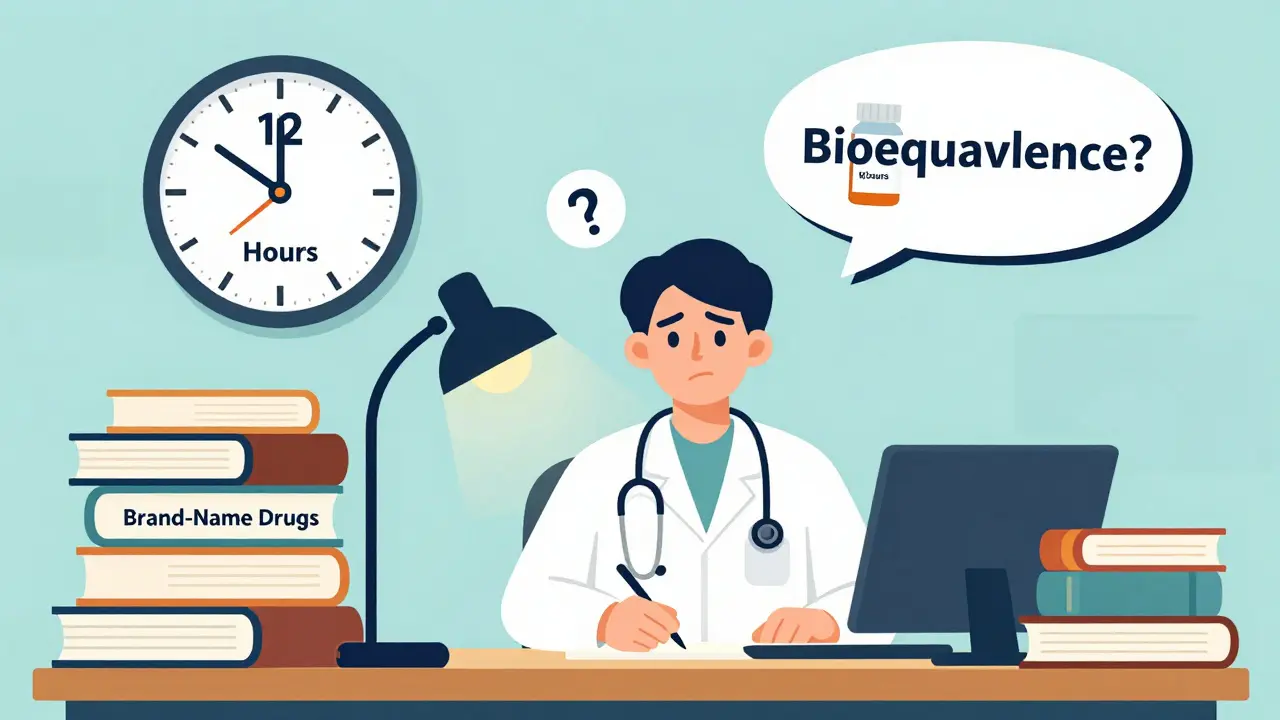
Doctors prescribe generics for 90% of all medications in the U.S. But do they really understand why those pills work the same as the brand names? The answer isn’t as simple as it seems.
What Doctors Are Taught (And What They’re Not)
Medical schools spend hundreds of hours teaching drug mechanisms, side effects, and dosing. But when it comes to generic drugs? Most students get less than 30 minutes. A 2024 survey in JAMA Internal Medicine found that pharmacology courses dedicate an average of 12 hours to brand-name drugs and under half an hour to generic substitution. That’s not a typo. It’s a systemic blind spot. The science behind generics is straightforward: a generic drug must prove it delivers the same amount of active ingredient into the bloodstream at the same rate as the brand. That’s called bioequivalence. The FDA requires the 90% confidence interval for absorption (AUC) and peak concentration (Cmax) to fall between 80% and 125% of the brand. In plain terms: the body gets the same dose, the same way. It’s not guesswork. It’s math. And it’s tested in 24-36 healthy volunteers before approval. Yet, many doctors graduate without ever seeing a bioequivalence study. They don’t learn how to read the data. They don’t learn why a generic methylphenidate tablet that meets FDA standards might still make a patient feel different - not because it’s less effective, but because inactive ingredients like fillers or coatings can change how fast the pill breaks down. That’s not a flaw in the generic. It’s a quirk of formulation. And without context, doctors assume the drug failed.The Myths That Stick
Misconceptions about generics aren’t just outdated - they’re deeply embedded in practice. A 2023 study of U.S. physicians showed that 68% of doctors admit to having “occasional concerns” about generic performance. The top worries? Warfarin and levothyroxine. Both have narrow therapeutic windows - small changes in blood levels can cause big effects. That’s why some neurologists and endocrinologists still avoid switching patients. But here’s the truth: the FDA applies the same 80-125% bioequivalence standard to warfarin generics as it does to ibuprofen. The difference isn’t in the science. It’s in perception. The 2016 Concerta controversy fueled this. Some patients reported reduced effectiveness after switching to a Teva generic methylphenidate. The FDA investigated. The generics met all bioequivalence criteria. The issue? Patient expectations. The pill looked different. The timing felt off. The brand name was gone. That’s not pharmacology. That’s psychology. Doctors who learned to prescribe by brand names in medical school keep prescribing by brand names. Case studies use brand names. Drug reps push brand names. Hospital formularies list brand names first. Even when a doctor knows generics are equivalent, the habit sticks. A 2023 AAMC analysis found that 78% of clinical case examples in textbooks use brand names. That’s not just tradition - it’s training.What Actually Changes Behavior
Knowledge doesn’t equal action. A 2015 study in Malaysia gave 30 doctors a 45-minute lecture on generics. Their knowledge scores jumped from 58.7% to 84%. But their prescribing habits? Stayed the same. They still wrote “Lipitor” instead of “atorvastatin.” Why? Because they watched senior doctors do it. Culture overrides curriculum. The real game-changer? Feedback loops. A 2025 study in Nature Scientific Reports showed that pharmacists who reviewed 100 prescriptions with feedback improved retention by 40%. The same principle applies to doctors. When a physician gets real-time data - like a pop-up in their EHR saying “This generic has the same bioequivalence profile as the brand, with 92% patient satisfaction in our system” - they start to trust it. Even better: the teach-back method. Instead of telling a patient, “This generic is just as good,” ask them: “Can you explain why we’re switching?” In one family practice, this cut patient questions about generics by 63%. Patients who could explain the science themselves were less likely to demand the brand. And doctors? They felt more confident.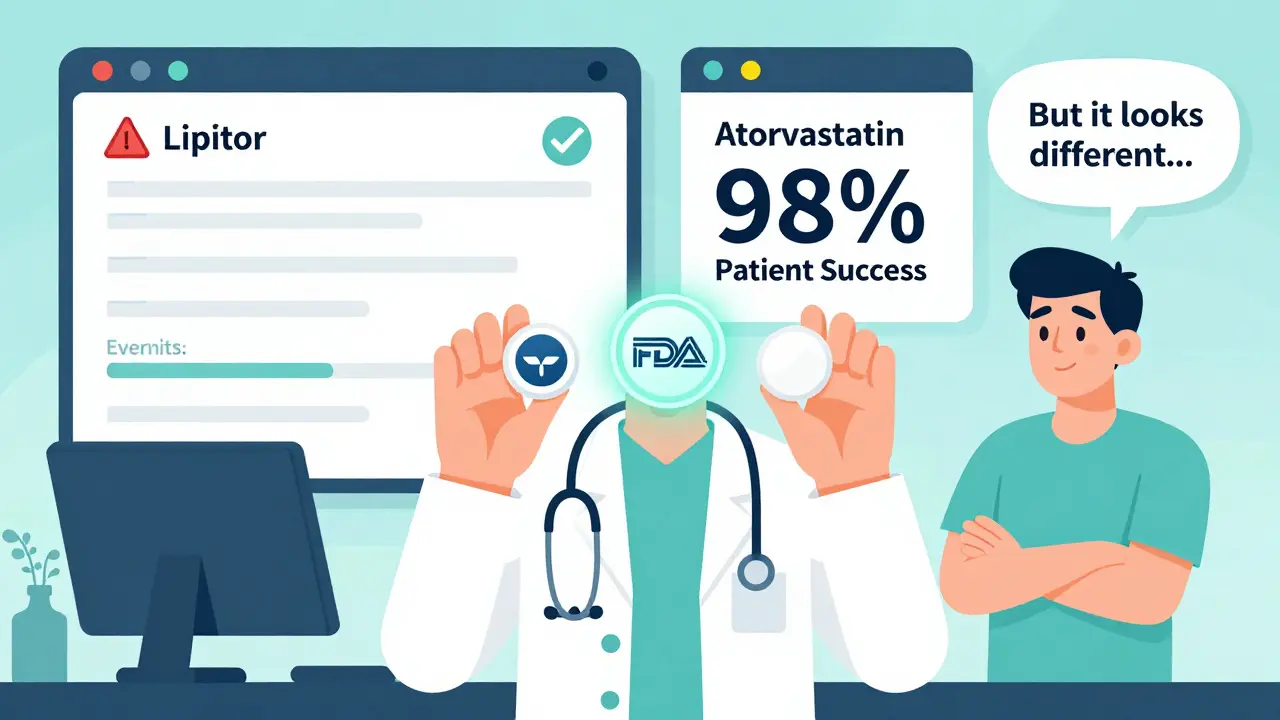
What’s Working Now
Some places are fixing this. Karolinska Institute in Sweden started requiring International Nonproprietary Names (INN) - like “metoprolol” instead of “Lopressor” - in all student prescriptions back in 2018. Graduates now prescribe generics 47% more often. That’s not magic. It’s habit formation. The FDA launched a new initiative in 2023: 15-minute microlearning modules on bioequivalence. They’re free, online, and designed for busy clinicians. One module walks you through a real bioequivalence study - the numbers, the confidence intervals, the FDA’s threshold. No jargon. Just facts. Electronic health records are starting to help too. By 2025, the FDA’s Digital Health Center of Excellence plans to embed bioequivalence data directly into EHRs. When a doctor clicks on a generic, they’ll see: “Bioequivalent to brand. 98% patient success rate in our network.” No guesswork. No doubt.Why This Matters - Beyond Cost
Generics aren’t just cheaper. They’re the backbone of accessible care. In the U.S., they make up 90% of prescriptions but only 22% of drug spending. That’s $156 billion saved annually by 2030 if we fully unlock their potential, according to the IMS Institute. But savings mean nothing if patients don’t take the meds. If a doctor hesitates to prescribe a generic because they’re unsure, the patient might skip it entirely. Or worse - they’ll pay out of pocket for the brand, skip doses, or stop treatment. That’s when chronic conditions flare up. That’s when hospital visits climb. The goal isn’t to push generics. It’s to push confidence. Confidence that the science is solid. Confidence that the system works. Confidence that the pill in your hand - no matter the label - will do what it’s supposed to.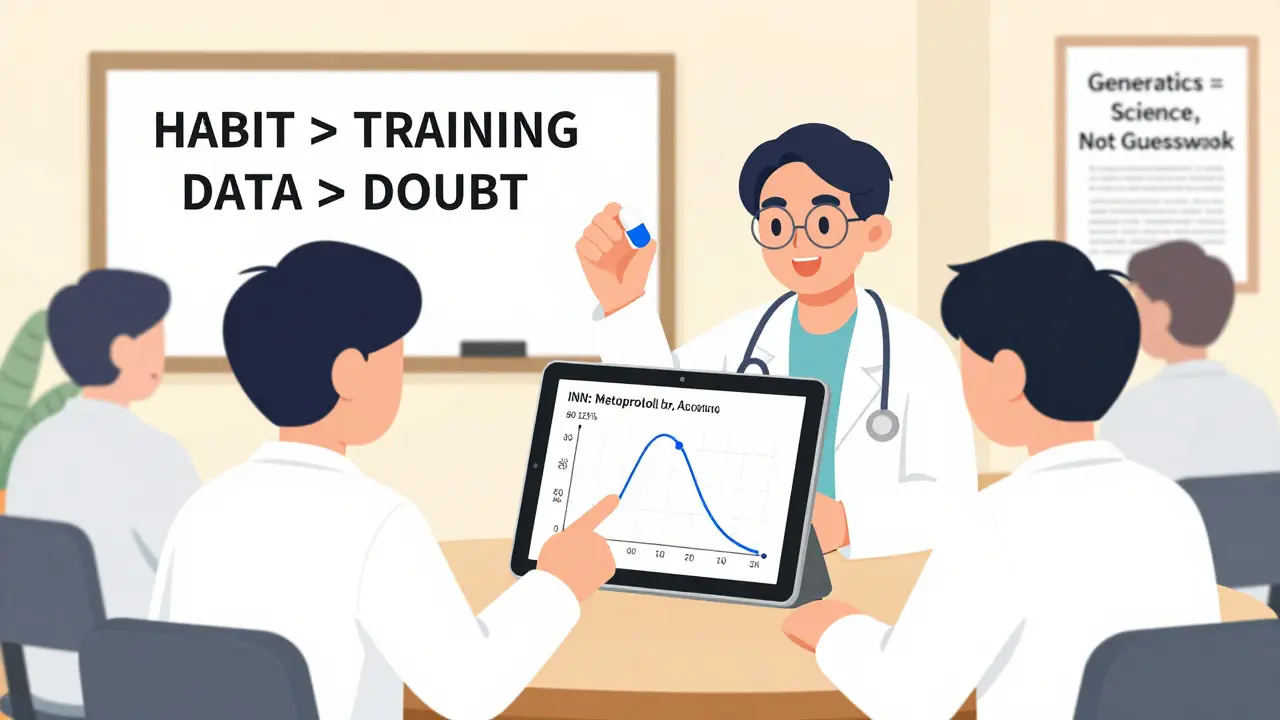
Where the System Still Falls Short
Only 38% of U.S. healthcare systems have EHR alerts that show bioequivalence data at the point of care. Only 43% of teaching hospitals offer formal generic drug education resources. And only 31% of doctors regularly use INN in prescriptions - even though it’s the standard in 100+ countries. Specialists are the biggest gap. Neurologists prescribe generics only 39% of the time. Psychiatrists, 47%. Primary care? 82%. That’s not because specialists are risk-averse. It’s because they’re trained to treat complex, fragile systems. They see the consequences when things go wrong. And they’ve been told - sometimes by their own mentors - that generics aren’t the same. The solution isn’t to shame them. It’s to arm them. With data. With feedback. With time.What You Can Do - Even If You’re Not a Doctor
If you’re a patient: ask your doctor why they’re prescribing a brand vs. a generic. Don’t accept “it’s better.” Ask: “Is there a generic that’s been proven to work the same?” If they hesitate, it’s not because they’re hiding something. It’s because they weren’t taught how to answer. If you’re in medical training: push for more generic education. Request case studies using INN. Ask for access to bioequivalence databases. Volunteer for pharmacy rotations. The more you see, the less you fear. If you’re a hospital administrator: integrate generic prescribing into evaluation metrics. Reward INN use. Install EHR alerts. Fund short training modules. You’re not just cutting costs. You’re building trust.The Bottom Line
Generics aren’t second-rate. They’re science-backed, rigorously tested, and widely used. But doctors aren’t being taught how to believe it. Not because they’re skeptical. Because they’re underinformed. The fix isn’t a big reform. It’s small, consistent changes: teach bioequivalence like you teach blood pressure targets. Require INN prescribing from day one. Give doctors real-time feedback. Let them see the data. Let them hear their patients say, “This worked just as well.” The science is settled. The question now is: will the system catch up?Are generic drugs really as effective as brand-name drugs?
Yes. Every generic drug must prove bioequivalence to the brand-name version before approval. That means it delivers the same amount of active ingredient into your bloodstream at the same rate. The FDA requires the absorption levels (AUC and Cmax) to fall within 80-125% of the brand. This standard applies to all drugs - from antibiotics to heart medications. Generics aren’t cheaper because they’re weaker. They’re cheaper because they don’t need to pay for advertising or patent recovery.
Why do some doctors still prefer brand-name drugs?
Many doctors were trained during a time when brand names dominated textbooks and drug reps. They learned to prescribe by brand, not by active ingredient. Even when they know generics are equivalent, the habit sticks. Workplace culture plays a big role - if senior doctors prescribe brands, juniors follow. Some also worry about narrow therapeutic index drugs like warfarin or levothyroxine, though the FDA applies the same bioequivalence standards to all classes. The issue isn’t science - it’s perception and training.
What’s the difference between bioequivalence and therapeutic equivalence?
Bioequivalence means the drug enters the bloodstream at the same rate and amount as the brand. Therapeutic equivalence goes further - it means the drug produces the same clinical effect and safety profile in real patients. All FDA-approved generics are considered therapeutically equivalent. But some doctors confuse the two. They think bioequivalence is just a lab test, not proof of real-world results. That’s not true. Bioequivalence is the gold standard for predicting therapeutic outcomes.
Can inactive ingredients in generics affect how a drug works?
Yes, but not in the way most people think. Inactive ingredients like fillers or coatings can change how fast a pill dissolves, which might affect how quickly you feel the effect - especially with extended-release drugs. That’s why some patients report feeling different after switching. But the total amount of active drug absorbed over time is still the same. The FDA requires this to be within 80-125%. If a patient reports a change, it’s often about timing or sensation, not effectiveness. Switching back to the brand doesn’t fix the problem - it just makes the patient feel more comfortable.
Why don’t medical schools teach more about generics?
Medical curricula are packed. Pharmacology courses focus on mechanisms, side effects, and brand-name drugs because that’s what’s historically been emphasized. Generics are often treated as an afterthought - maybe a single lecture. There’s no standardized requirement for teaching bioequivalence. But schools like Karolinska Institute have shown that requiring International Nonproprietary Names (INN) in prescriptions increases generic prescribing by 47%. It’s not about time - it’s about priority.
How can I know if my generic drug is truly equivalent?
Check the FDA’s Orange Book, which lists all approved generics and their therapeutic equivalence ratings. If a generic is rated “AB,” it’s considered interchangeable with the brand. Your pharmacist can also tell you. But the best way? Ask your doctor: “Is this generic FDA-approved as equivalent?” If they can’t answer confidently, it’s a sign they need more education - not that the drug is suspect.
Will using generics hurt my insurance coverage?
No - in fact, it’s the opposite. Most insurance plans require you to try the generic first before covering the brand. If you refuse the generic, you might pay more out of pocket. Some plans even waive copays for generics. Using generics saves you money and helps keep overall drug costs down for everyone.




Man, I wish I’d known this back in med school. We spent weeks on brand-name drugs like Lipitor and Zoloft, but generics? One slide. One. And now I’m prescribing them daily and still feel like I’m guessing half the time. It’s wild how the system trains us to trust the brand, not the science. I’ve had patients swear their generic Adderall doesn’t work - same active ingredient, same FDA approval - but they’re convinced because the pill’s a different color. It’s not the drug, it’s the packaging. We need to fix how we teach this, not just how we prescribe.
And honestly? The EHR pop-ups the post mentioned? That’s the future. If my system told me, ‘This generic has 98% patient satisfaction and same bioequivalence as brand,’ I’d switch 100% of the time. But right now? I’m flying blind. And so are my patients.
Let’s be real - the bioequivalence standard of 80-125% isn’t perfect, but it’s the best we’ve got. The FDA doesn’t just slap a label on a pill and call it good. They run trials with real people, measure blood levels, and require statistical confidence. That’s not magic, it’s math. But doctors aren’t taught to read those studies, so they default to brand names because they’re familiar. It’s not ignorance, it’s lack of training.
And yeah, inactive ingredients can change dissolution rates - especially with extended-release meds. But that doesn’t mean the drug fails. It means the formulation differs. If a patient feels a difference, it’s often psychological or about timing, not efficacy. The real problem? We don’t talk about this enough in clinics. We just assume the patient’s wrong. We should be asking, ‘What changed?’ not ‘Why are you complaining?’
Stop pretending generics are perfect. The 80-125% range is a joke. That’s a 45% swing in absorption. If you’re on warfarin and your INR jumps from 2.1 to 3.2 because your generic dissolved faster? That’s not bioequivalence - that’s a risk. And don’t give me that FDA nonsense. They approve generics based on healthy volunteers. What about elderly patients with liver disease? Or kids? The data doesn’t reflect real-world use. And don’t even get me started on the Teva methylphenidate fiasco - patients were crashing, and the FDA said ‘all good.’ Yeah right. This is corporate capture disguised as science.
Also why are we even talking about this? The brand name drugs are better. Always have been. Always will be. If you can afford it, take the brand. End of story.
Ugh. Another one of these ‘trust the science’ rants. I’ve been on generics for 12 years. Every single time I switch, I feel like crap. Headaches. Anxiety. Insomnia. My doctor says ‘it’s the same chemical.’ But my body says otherwise. And now you want me to believe that my lived experience is just ‘psychology’? That’s gaslighting. The system doesn’t care about patients. It cares about saving a few bucks while we pay with our health. You think I don’t know how much cheaper generics are? I do. But I’m not a statistic. I’m a person who feels the difference. And I’m not going to be silenced by some PhD in a lab coat telling me I’m imagining it.
Also - why is this post so long? Did you copy-paste a textbook?
Respected colleagues, this discourse is profoundly significant. In India, generic medications constitute over 95% of pharmaceutical consumption. Yet, the medical curriculum remains heavily biased toward proprietary nomenclature. The Karolinska model - mandating INN usage - is not merely advisable but imperative for global equity. Furthermore, the FDA’s bioequivalence thresholds, while scientifically robust, are culturally alien to many developing nations where pharmacovigilance infrastructure is under-resourced. The challenge is not merely educational but systemic. We must harmonize global training standards to prevent therapeutic fragmentation. Thank you for illuminating this critical gap.
With profound respect,
Rakesh Kakkad, MD, PhD (Pharmacology), AIIMS Delhi
I’m a PA and I’ve been prescribing generics for years. Honestly? I used to avoid switching people on warfarin or levothyroxine just because I didn’t want to deal with the follow-up calls. But then I started checking the FDA’s Orange Book before prescribing. Found out most of the generics are rated AB - meaning interchangeable. And I started telling patients, ‘This is the same drug, just cheaper.’ No magic, no conspiracy.
One guy came back and said, ‘I’ve been on this for six months. I feel better than I did on the brand.’ Turns out he was paying $300 a month before. Now it’s $8. He wasn’t sick because the drug didn’t work. He was sick because he couldn’t afford it.
Maybe the problem isn’t the generics. Maybe it’s the cost. And the fear we’ve been taught to feel about saving money.
Generics are a Western capitalist scam. The FDA is a puppet of Big Pharma. The 80-125% range is a loophole designed to allow inferior products into the market. Real medicine comes from Germany, Switzerland, Japan - countries with real standards. Why do you think European patients don’t have this problem? Because their regulators don’t bow to profit. Your ‘bioequivalence’ is a myth. The active ingredient is the same, yes - but the manufacturing quality? The excipients? The stability? Unregulated. Unmonitored. Dangerous. This is not science. This is corporate colonialism disguised as healthcare reform.
Let’s not mince words - this isn’t about science. It’s about control. The medical-industrial complex built its empire on brand names. Doctors were trained to worship the logo. Pharmacies were incentivized to push the expensive stuff. Patients were conditioned to believe that if it doesn’t have a fancy name, it’s not real medicine.
But here’s the truth: the pill you swallow doesn’t care if it says ‘Lipitor’ or ‘atorvastatin.’ Your liver doesn’t care. Your arteries don’t care. Only your wallet and your ego do. And that’s the real disease. We’ve turned healthcare into a branding contest. Generics aren’t the problem. Our collective delusion is.
Wake up. The pill is the pill. The brand is a marketing stunt.
I switched my thyroid med to generic and didn’t notice a thing.
So let me get this straight - we’re supposed to believe that a $3 pill made in a factory in Hyderabad is chemically identical to a $300 pill made in a Swiss lab with gold-plated machinery... but somehow, the Swiss one makes you feel better because it’s got a nicer logo?
It’s like saying a Honda Civic and a Rolls-Royce are the same because they both have four wheels and an engine. The difference isn’t in the fuel - it’s in the ride.
And yet, somehow, the FDA says they’re interchangeable. I’m not saying they’re wrong. I’m just saying... I’d rather pay the extra $297 for the Rolls. At least I know the guy who made it got paid enough to afford coffee.
Also - who wrote this? A pharmaceutical lobbyist? Or just someone who really hates marketing?
The bioequivalence paradigm is fundamentally flawed. The AUC and Cmax metrics are reductionist proxies for complex pharmacokinetic-pharmacodynamic interactions. Clinical outcomes are modulated by epigenetic variability, gut microbiota, and polypharmacy - none of which are accounted for in the 24–36 subject trials. The FDA’s standard is a regulatory artifact, not a biological truth. Furthermore, the ‘AB’ rating system conflates bioequivalence with therapeutic interchangeability - a dangerous semantic blurring that endangers vulnerable populations. This is not evidence-based medicine. It is bureaucratic convenience masquerading as science.
I used to be one of those doctors who only prescribed brands for anything with a narrow window - until I started tracking outcomes. I had a patient on levothyroxine who kept complaining of fatigue. We switched brands, then switched to generic. No change. Then I asked her - ‘When did you start feeling off?’ Turns out, she’d switched to a new pharmacy that used a different filler. The generic was fine. The pharmacy’s version was the issue.
Turns out, it’s not the generic. It’s the batch. And if you don’t know how to check the lot number or talk to your pharmacist, you’re stuck blaming the drug.
So I started telling patients: ‘If you feel different after switching, call your pharmacist. They can tell you if it’s the same manufacturer or a different one.’ It’s not about trust in generics. It’s about trust in the system. And that’s something we can fix - one conversation at a time.
Let’s be honest - most doctors don’t know what bioequivalence even means. I’ve seen attending physicians say ‘generic doesn’t have the same excipients’ like it’s a flaw. Excipients aren’t active ingredients. They’re the sugar coating. The pill’s job is to deliver the drug. Not to be a luxury experience.
But here’s the real issue: the system rewards brand loyalty. Drug reps give free pens. Hospitals get kickbacks. Textbooks use brand names. Medical students grow up thinking ‘Zoloft’ is the drug and ‘sertraline’ is just the boring version. We’re not teaching science - we’re teaching branding.
And until we fix that, no amount of EHR alerts or microlearning modules will change a thing.
I hate generics. Always have. Always will. My cat even refuses to eat the generic flea meds.