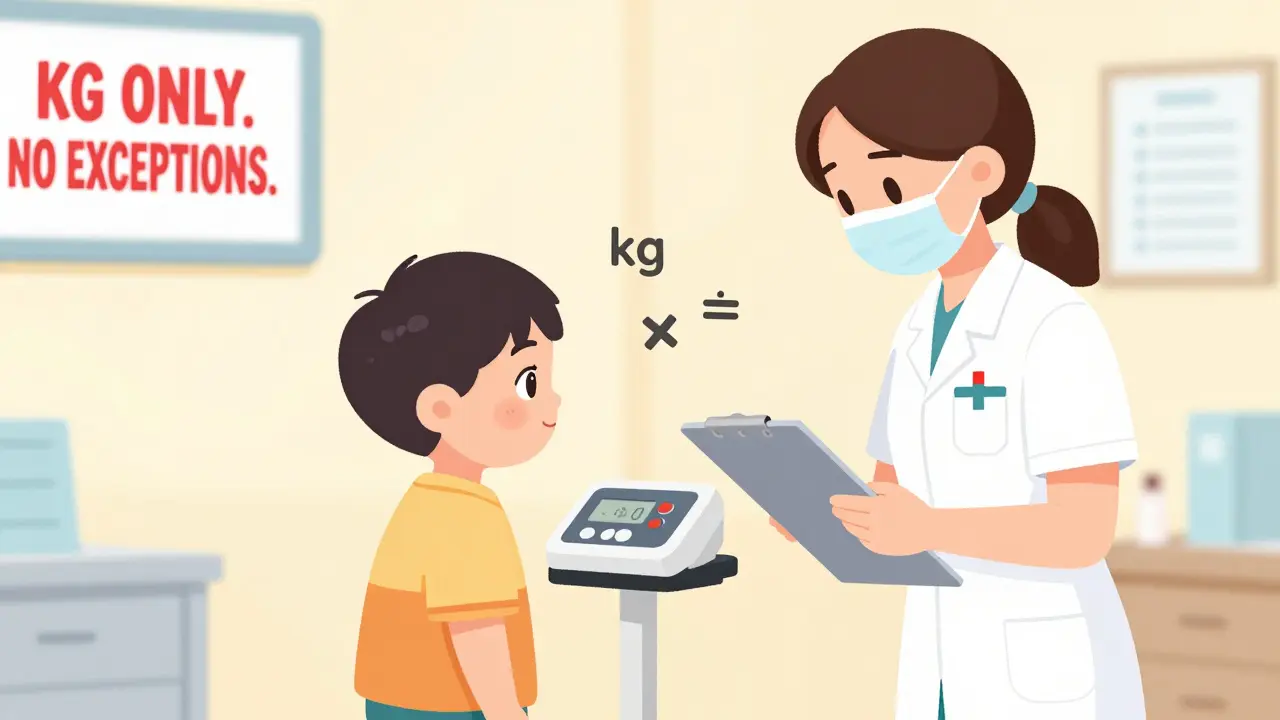
When a child gets sick, giving the right dose of medicine isn’t just important-it’s life-or-death. Too little, and the infection doesn’t go away. Too much, and you risk organ damage, seizures, or worse. That’s why weight-based dosing is the gold standard in pediatric care today. It’s not a suggestion. It’s a rule. And it’s backed by decades of research, real-world data, and strict safety protocols. Most adults don’t realize that a child’s body doesn’t just shrink down from an adult’s. Their organs work differently. Their water content is higher. Their liver and kidneys process drugs at different speeds. A 10-year-old and a 50-kilogram adult might weigh the same, but they’ll handle a drug in completely different ways. That’s why guessing by age-"give half the adult dose for a child"-is dangerous. Studies show age-based dosing leads to errors in nearly 3 out of 10 cases, especially in kids who are unusually small or large for their age. The math behind weight-based dosing is simple, but the details matter. You start with the child’s weight in kilograms. Not pounds. Not rounded guesses. Exact kilograms, measured to the hundredth of a kilogram. Why? Because if you convert 22 pounds to 10 kg instead of 9.98 kg, you’ve already introduced a 2% error. That might sound small, but in a 5 mg/kg drug, that’s a 0.1 mg difference per dose. Multiply that by 10 doses a day? That’s 1 mg extra per day. Over five days? 5 mg. For some drugs, that’s enough to cause toxicity. Here’s how it works step by step. First, weigh the child on a calibrated scale. Use kilograms only. No exceptions. Many hospitals now put bright red stickers on scales that say "WEIGH IN KG ONLY" after years of near-misses from nurses accidentally using pounds. Second, multiply the weight in kg by the prescribed dose per kg per day. For example, if a 10.5 kg child needs amoxicillin at 40 mg/kg/day, that’s 10.5 × 40 = 420 mg total per day. Third, split that total by how many times a day the dose is given. If it’s twice daily, each dose is 210 mg. No rounding until the final number. Round too early, and errors pile up. Body surface area (BSA) is another method, used mostly for chemotherapy drugs. It uses height and weight together with the Mosteller formula: √(weight in kg × height in cm / 3600). It’s more accurate for these drugs, but it’s slower. A 2023 study found it adds 47 seconds per dose. In an emergency, that’s too long. That’s why 87% of hospitals rely on weight-based dosing for most medications. But even perfect math won’t save you if no one double-checks. That’s where the real safety net kicks in. The Joint Commission requires independent double-checks for high-alert medications in children. That means two licensed providers-usually a nurse and a pharmacist, or two nurses-each calculate the dose separately. If one says 200 mg and the other says 210 mg? You stop. You investigate. You don’t give the drug until you know why. One pediatric nurse in Michigan shared how this saved a child last year. A resident ordered 200 mg of a drug for a 10 kg child. The calculated safe maximum was 40 mg/kg/day, so 400 mg total per day. Twice daily meant 200 mg per dose. The nurse thought, "That’s the full daily dose, not per dose." She caught it. The resident had forgotten to divide by two. That mistake would’ve been a 10-fold overdose. Double-checks caught it. The child was fine. Errors still happen. The Institute for Safe Medication Practices reported over 1,200 pediatric dosing errors in 2022. The top three? Unit conversion mistakes (like using pounds instead of kg), decimal point slips (writing 2.0 mg instead of 20 mg), and ignoring kidney or liver function. A child with immature kidneys might need 60% less of an aminoglycoside, no matter their weight. A child with obesity might need dosing based on ideal body weight, not actual weight, especially for water-soluble drugs. That’s why hospitals are upgrading their systems. Epic Systems, one of the biggest EHR providers, rolled out pediatric dosing modules in mid-2023. These tools auto-calculate doses, flag out-of-range numbers, and block orders that exceed safety limits. One hospital in California cut errors by 52% after adding these alerts. But tech alone isn’t enough. Nurses still need to know how to do the math by hand. What if the computer goes down? What if the scale is broken? What if the EHR doesn’t have the right drug in its database? Training is mandatory. The Pediatric Nursing Certification Board requires all pediatric nurses to pass a 25-question test every year with at least a 90% score. No exceptions. And it’s not just nurses. Pharmacists, residents, even doctors get retrained. Because in pediatrics, there’s no room for "I thought I knew this." The future is getting smarter. The NIH’s Pediatric Trials Network has enrolled over 15,000 children since 2022 to build better dosing rules for common drugs. And in 2023, the FDA announced that all new drug applications must include pediatric dosing algorithms by 2025. That means we’ll soon have more precise, evidence-based guidelines instead of relying on old estimates. But here’s the truth: no matter how advanced the tech gets, weight-based dosing with double-checks will stay the foundation. Why? Because it works. It’s simple. It’s measurable. And when you’re dealing with a child’s life, you don’t need fancy. You need reliable. A 2023 study in the Journal of Pediatric Pharmacology and Therapeutics found that when weight-based dosing is paired with double-checks, serious medication errors drop by 68%. That’s not a statistic. That’s 68% fewer kids who almost died because someone made a mistake. That’s why every pediatric unit in every children’s hospital in the U.S. and beyond does it the same way: weigh in kg, calculate precisely, verify twice. It’s not complicated. It’s just critical.
What if the child is overweight or obese?
For kids with BMI over the 95th percentile, dosing gets trickier. For water-soluble drugs (like antibiotics or antivirals), doctors use adjusted body weight: Ideal Body Weight + 0.4 × (Actual Weight - Ideal Weight). For fat-soluble drugs (like some seizure meds or sedatives), they use actual weight. About 78% of children’s hospitals use this method. The key? Never use actual weight for hydrophilic drugs-it can lead to overdosing.Why not just use age-based dosing?
Age-based dosing was common in the 1980s. Today, it’s outdated. A 2022 study showed it causes errors in 29% of cases. Why? A 2-year-old weighing 8 kg and a 2-year-old weighing 16 kg are both "2 years old," but their drug needs are completely different. Weight tells the real story.What’s the difference between Clark’s Rule and modern weight-based dosing?
Clark’s Rule, from 1905, used a child’s weight divided by 150 pounds to estimate dose. It’s outdated. A 2021 study found it overestimates doses by 15-22% in children under 5. Modern mg/kg dosing is far more accurate and has replaced it in all major guidelines.How often should weight be rechecked?
For critical drugs-like antibiotics, insulin, or chemo-weight must be measured within 24 hours of dosing. For stable patients on routine meds, weekly is acceptable. But in the ER or ICU? Every time. Weight can change fast in sick kids.What’s the biggest mistake in pediatric dosing?
The #1 error? Using pounds instead of kilograms. It’s happened over and over. One nurse in Texas gave a 10-fold overdose because the scale was in pounds and she didn’t convert. The child survived, but barely. Now, every scale in that hospital has a red sticker. "KG ONLY. NO EXCEPTIONS."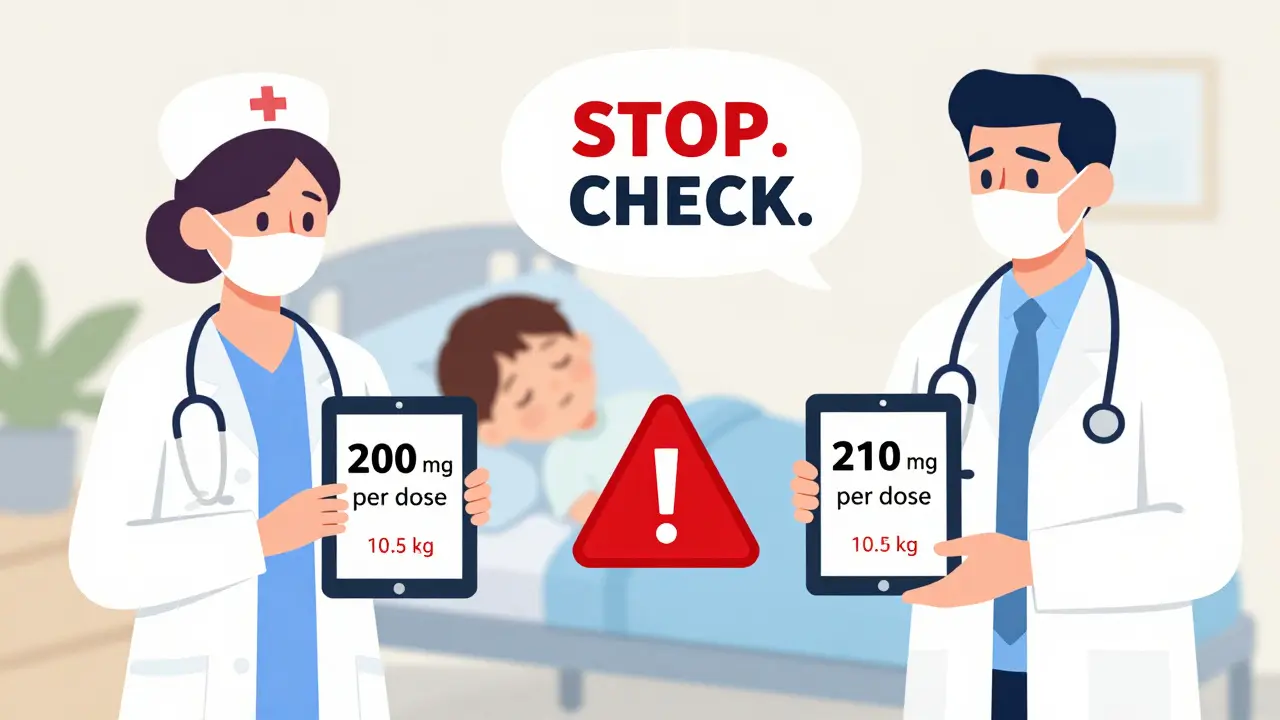
Can electronic health records eliminate all errors?
No. They help-big time. But they can’t replace human judgment. A 2023 study found that 40% of dosing errors still occurred even with alerts, because staff overrode them without understanding why. The system flags, but the provider must think. That’s why double-checks are still required.Are there drugs that don’t use weight-based dosing?
Yes. A few. Vaccines, some topical creams, and certain antivirals (like acyclovir for herpes) use body surface area or fixed doses. But for 92% of pediatric medications, weight is the starting point. Always check the drug’s prescribing information.What happens if a child’s weight changes during treatment?
If a child gains or loses weight significantly-say, 10% or more-re-calculate the dose. This is common in kids with infections, cancer, or eating disorders. Don’t assume the original dose still fits. Reassess.Is double-checking really necessary for every dose?
For high-alert drugs-insulin, opioids, chemotherapy, heparin, IV antibiotics-yes. Always. For routine antibiotics or fever reducers? Many hospitals still do it. It’s not just about safety. It’s about culture. When every dose is checked, mistakes become rare.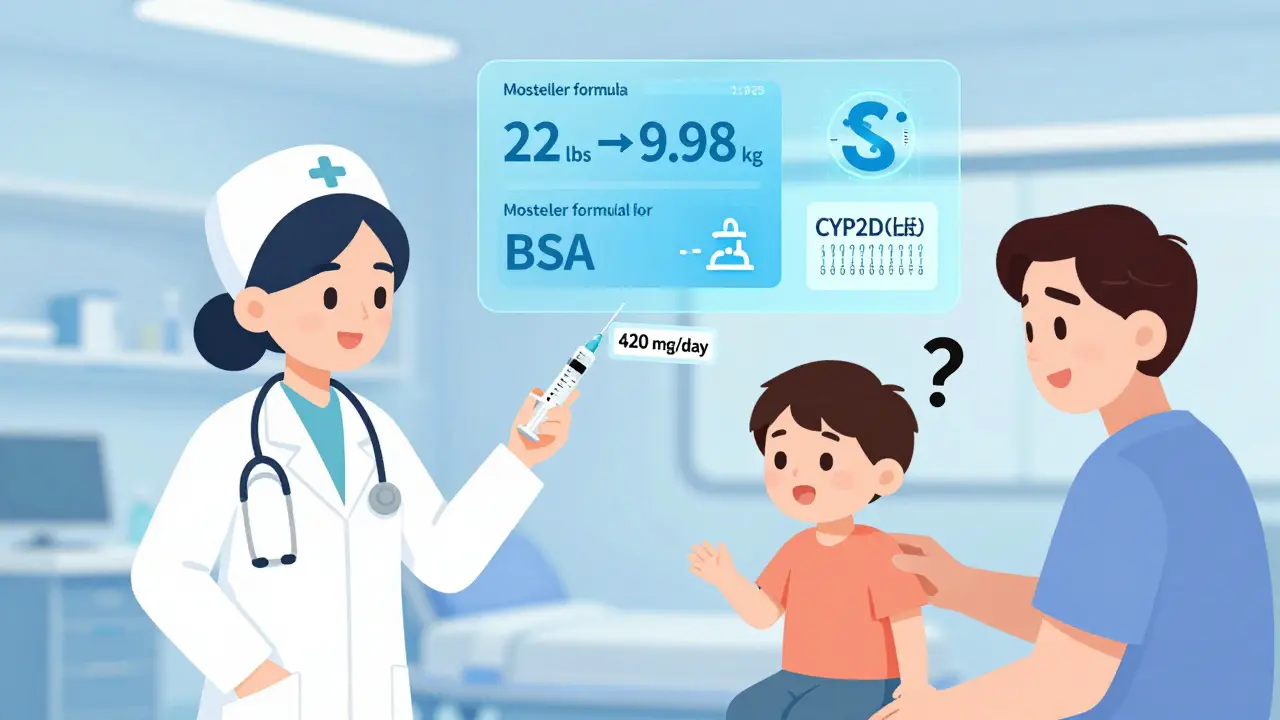
How do you train new staff?
Most hospitals use simulation labs. Nurses practice on mannequins with fake weights and doses. They get scored on speed, accuracy, and whether they double-checked. If they miss one step, they redo the scenario. No one graduates until they get it right every time.What’s the role of parents?
Parents should always ask: "What’s the dose in mg?" and "How did you calculate it?" If they’re unsure, they should say so. Hospitals that encourage parental involvement see 30% fewer errors. A parent’s question can be the last line of defense.What’s the future of pediatric dosing?
We’re moving toward pharmacogenomics-testing genes to see how a child metabolizes drugs. For example, some kids process opioids too slowly and get overdosed even with "correct" weight-based doses. Testing for CYP2D6 and CYP2C19 genes will soon be routine. But even then, weight will still be the first step. The foundation doesn’t change. The layers just get smarter.Final thought
In pediatrics, there’s no such thing as "close enough." A 0.1 mg error isn’t a typo. It’s a risk. Weight-based dosing isn’t a suggestion. It’s the law. And double-checking isn’t extra work-it’s what keeps kids alive. Every nurse, every pharmacist, every doctor who’s ever saved a child from a dosing mistake knows this: precision isn’t optional. It’s the job.Why is weight-based dosing better than age-based dosing for children?
Weight-based dosing accounts for actual body size and physiology, while age-based dosing assumes all children of the same age have similar body composition. Studies show age-based dosing leads to errors in 29% of cases, especially in children who are unusually small or large. Weight-based dosing reduces medication errors by 43%, according to the American Academy of Pediatrics.
How do you convert a child’s weight from pounds to kilograms for dosing?
Divide the weight in pounds by 2.2. For example, 22 pounds equals 10 kg (22 ÷ 2.2 = 10). Never round until after the final calculation. Use the exact value (e.g., 22.4 lbs = 10.18 kg) to avoid cumulative errors. Many hospitals now require scales to display weight only in kilograms to prevent conversion mistakes.
What is the purpose of a double-check in pediatric dosing?
A double-check involves two independent providers calculating and verifying the dose separately. This reduces serious medication errors by 68%, according to the American College of Clinical Pharmacy. It catches mistakes like unit confusion, decimal errors, or calculation oversights before the drug is given.
Which medications require body surface area (BSA) instead of weight-based dosing?
Chemotherapy drugs often use BSA because their effectiveness and toxicity are closely tied to surface area rather than weight. The Mosteller formula (√(weight in kg × height in cm / 3600)) is standard. BSA dosing is about 18% more accurate for these drugs than weight-based alone, though it takes longer to calculate.
What are the most common dosing errors in pediatric care?
The top three are: unit conversion errors (using pounds instead of kg), decimal point mistakes (writing 2.0 mg instead of 20 mg), and failure to adjust for organ function (like kidney or liver impairment). According to the Institute for Safe Medication Practices, these account for over 80% of pediatric dosing errors.
How do hospitals ensure staff are competent in pediatric dosing?
The Pediatric Nursing Certification Board requires annual competency testing with a 90% passing score on a 25-question exam covering weight conversion, dose calculation, and safety checks. Hospitals also use simulation training and mandatory retraining after any near-miss incident.
What should be done if a child gains or loses significant weight during treatment?
If a child’s weight changes by 10% or more during treatment, the dose must be recalculated. This is especially important for drugs with narrow therapeutic windows, like antibiotics, anticonvulsants, or chemotherapy. Never assume the original dose is still appropriate.
Are electronic health records (EHRs) enough to prevent dosing errors?
No. While EHRs with built-in dose calculators and safety alerts reduce errors by up to 52%, staff can override warnings without understanding the risk. Human double-checks remain essential. Technology supports, but doesn’t replace, clinical judgment.
How is dosing adjusted for obese children?
For hydrophilic drugs (water-soluble), use adjusted body weight: Ideal Body Weight + 0.4 × (Actual Weight - Ideal Body Weight). For lipophilic drugs (fat-soluble), use actual weight. This approach is used in 78% of children’s hospitals to avoid overdosing or underdosing.
What role do parents play in preventing dosing errors?
Parents should ask: "What’s the exact dose in milligrams?" and "How was it calculated?" Hospitals that encourage parental involvement report 30% fewer errors. A simple question from a parent can catch a mistake before it reaches the child.






Man, I’ve seen so many nurses panic when a kid comes in weighing 18.7 lbs and the scale says ‘lbs’ instead of ‘kg’-it’s like watching a slow-motion car crash. But once you get the rhythm? Weigh, calculate, double-check. It’s muscle memory. I once caught a resident who ordered 500mg of amoxicillin for a 5kg preemie. He thought ‘40 mg/kg’ meant 40mg total. I just said ‘Dude, 5 x 40 = 200.’ He turned pale. We saved that baby. Weight isn’t just a number-it’s a lifeline.
So we’re telling kids to weigh in kg… but the whole system still uses pounds? 😅 I’m just saying-why not just make the whole world metric? 🤷♂️ Also, double-checks? Cute. We still have people overriding alerts like they’re unlocking a phone. 🤖💥
LET ME TELL YOU SOMETHING-THIS ISN’T JUST MEDICAL PRACTICE, THIS IS A CULTURAL CRISIS! 🚨 We let unlicensed techs handle pediatric meds? We let EHRs override safety? We let nurses who ‘think they know’ skip the double-check? NO. NO. NO. This isn’t about math-it’s about accountability. Someone’s child almost died because a nurse didn’t convert pounds? THAT’S NOT A MISTAKE. THAT’S NEGLIGENCE. AND WE’RE STILL LETTING IT HAPPEN! 🤬 I’ve seen it. I’ve reported it. I’ve cried in the supply closet. And now? I’m screaming into the void. Someone needs to lose their license. Someone. Right. Now.
Did you know the WHO pushed metric in the 80s to control population? And now they’re forcing kg on kids’ meds? 🤔 I read a report-70% of pediatric errors happen in states that adopted federal EHR mandates. Coincidence? I think not. They want us dependent on tech so they can track every dose, every child, every breath. And when the system glitches? You’re left guessing. That’s not safety. That’s control. 🇺🇸 I still use a manual calculator. And I weigh my niece in pounds. Because I choose freedom.
Okay but why are we still doing this manually? Why not just scan the kid’s barcode and auto-calculate? The system already knows their weight from last visit. Why are we wasting time on math? This feels like 1998.
Y’all are overcomplicating this. 🤡 Weigh in kg → multiply → check twice → done. The real issue? People think they’re too busy to double-check. So they just… don’t. Then they blame the system. Nah. It’s laziness. And it’s killing kids. Not the scale. Not the EHR. YOU. 💥
OMG I LOVE THIS POST!! 🥹💖 I work in pediatrics and I do the double-checks every time-even for Tylenol. I used to think it was overkill… until a little girl almost got 10x her dose because someone wrote ‘5.0’ instead of ‘50’. I cried. Then I made a sticky note: ‘DOUBLE CHECK OR GO HOME’. It’s on my badge now. 🙌 Also… parents asking questions? YES. I wish more would. You’re not being rude-you’re saving lives. ❤️
Weight-based dosing isn’t the solution. It’s a band-aid. The real problem? We still treat children as miniature adults. We don’t have enough pediatric-specific pharmacokinetic data. We rely on extrapolated adult studies. And now we’re slapping on EHR alerts like they’re magic. The truth? We’re flying blind. The math is just theater. Real progress? Requires clinical trials. Not stickers. Not double-checks. Science.