When you finish a prescription, you don’t just toss the bottle in the trash. That label? It’s not just paper and ink-it’s your name, your doctor’s name, your condition, your prescription number, and sometimes even your birth date. All of it, perfectly readable. And if someone finds that bottle in your recycling bin, they can use that info to steal your identity, fake prescriptions, or commit insurance fraud. The FTC says prescription labels are one of the top five sources for identity theft. In 2021 alone, over 412,000 cases in the U.S. were tied to stolen pharmacy data. That’s not a small risk. It’s a real, avoidable danger-and it starts with what you do with that empty bottle.
Why Just Throwing It Away Isn’t Enough
You might think, "I’ll just peel off the label." But modern prescription bottles use waterproof acrylic adhesive that’s designed to stick hard. In tests by Titan Labs, manual peeling left behind 92% of the data stuck in the sticky residue. Even if you scrape it off, the ink often stays visible. A 2023 study found that 63% of "blackened" labels could still be read using smartphone camera apps and infrared filters. Criminals don’t need fancy gear-just a phone and a free photo-editing app. That’s why the DEA and FTC both say: complete removal of personal info is required, not just covering it up.Method 1: Chemical Dissolution (Best for Reusing Bottles)
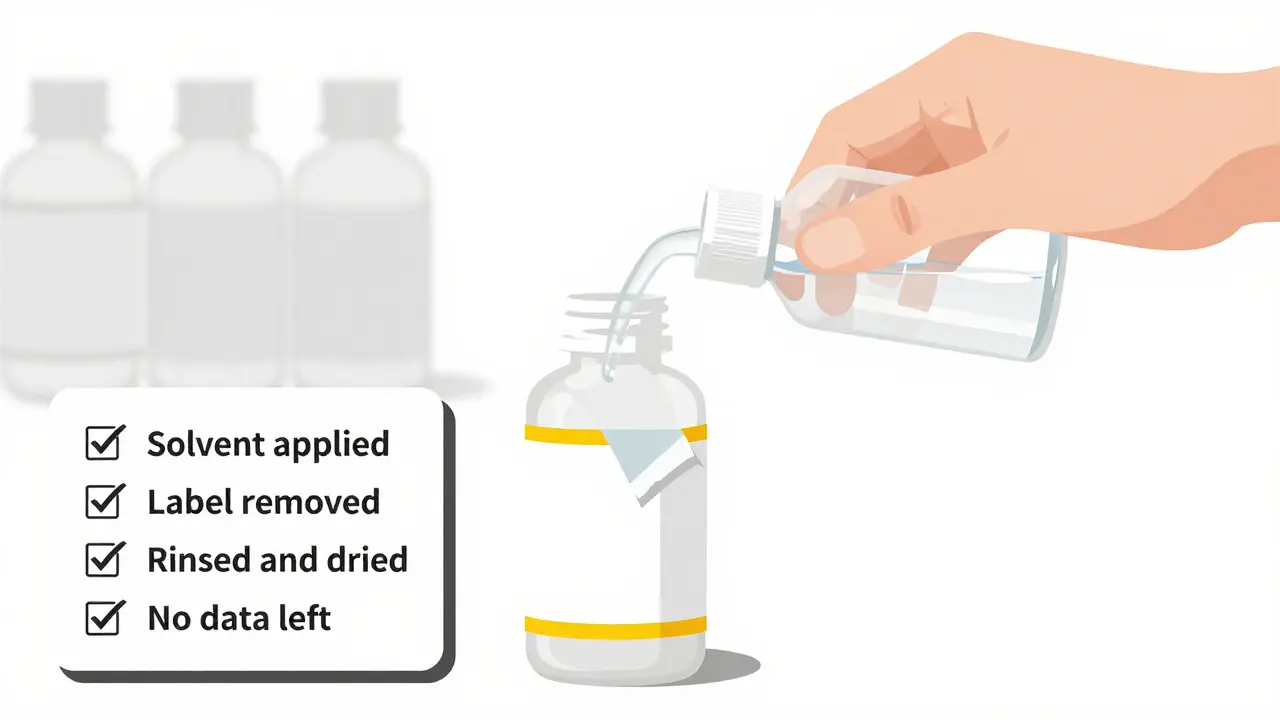
If you plan to reuse your pill bottles-for vitamins, supplements, or even craft projects-you need a clean, residue-free surface. The most reliable way is using a solvent designed for this exact purpose. Titan Labs’ Cleanup Solvent-22 is one of the few products tested and proven to work. It’s an acetone-based formula that breaks down the adhesive in 15 to 20 seconds. Here’s how to use it:- Place the bottle on a flat surface in a well-ventilated area.
- Saturate the label completely with the solvent. Don’t spray-pour or dab it on with a cloth.
- Wait 15-20 seconds. You’ll see the label start to loosen.
- Gently peel the label off with your fingers. No tools needed.
- Rinse the bottle with warm water and dry it.
Method 2: Permanent Marker (Best for Disposal)
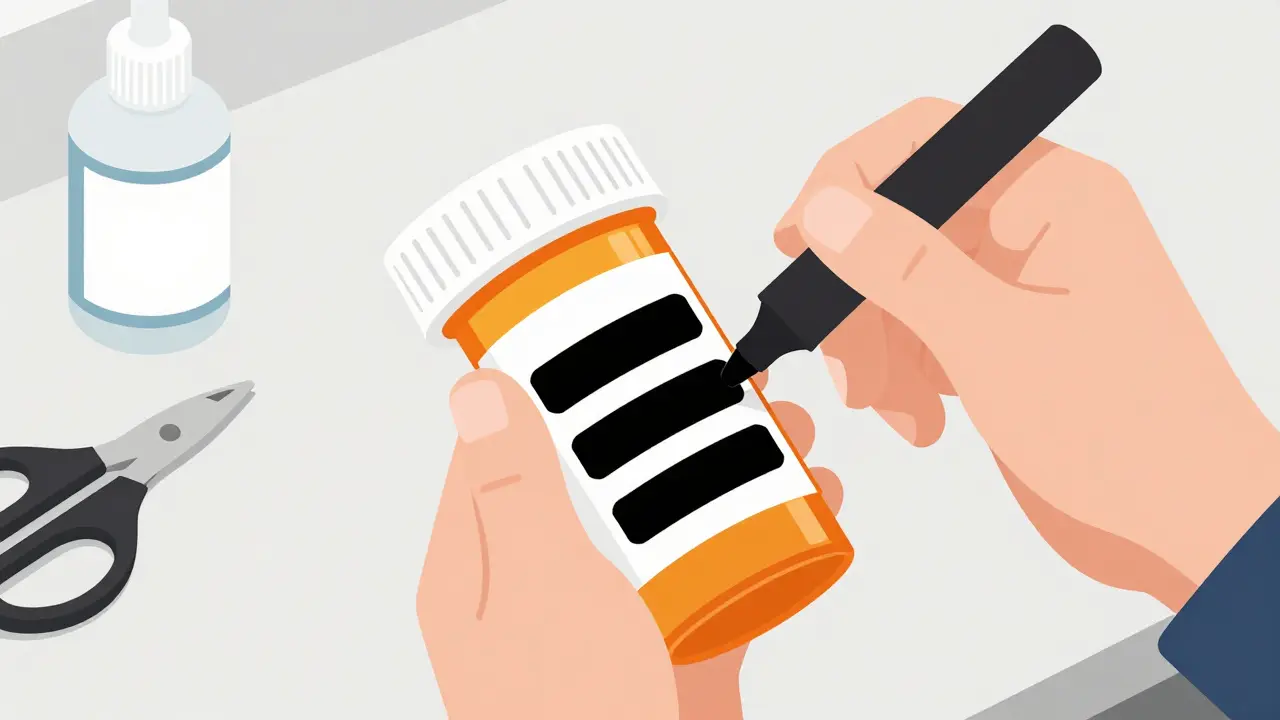
If you’re just throwing the bottle away, you don’t need to remove the label-you need to make sure no one can read it. The CHOC hospital system recommends using a black permanent marker, like a Sharpie. But it’s not as simple as scribbling over it.- Apply three thick, overlapping layers of black ink over every word, number, and symbol on the label.
- Wait 10 seconds between layers so the ink soaks in.
- Let it dry for at least 2 minutes.
- Hold the bottle up to a bright light. If you see any text shining through, add another layer.
Method 3: Physical Removal (Best for Bulk Disposal)
If you have a dozen or more empty bottles, and you’re not reusing them, the cleanest solution is shredding. But not with your home paper shredder. Regular shredders can’t handle plastic labels. You need a cross-cut shredder designed for medical waste. Services like LegalShred.com offer mail-in shredding for prescription bottles. They guarantee 100% destruction. But for most people, this isn’t practical. It’s expensive and slow. Instead, here’s a better alternative: cut the label off. Use heavy-duty scissors or a utility knife to cut around the label, leaving a 1-inch border around the bottle. Then, cut the label into small strips or pieces. This makes it nearly impossible to reconstruct any data. Combine this with marker obscuration on the pieces for extra safety. The DEA accepts this method during National Prescription Drug Take-Back Day events.What Doesn’t Work
Don’t waste your time with these methods:- Vinegar or soapy water: They soften the adhesive but don’t remove ink. In CHOC tests, 78% of labels still had readable data after soaking.
- Hairdryer heat: Melts the adhesive slightly, but leaves the label stuck. Only 63% success rate.
- Just ripping it off: Leaves behind sticky residue with your name and medical info still visible.
- One layer of marker: You’re inviting data recovery. Always use three.
Timing Matters
The longer you wait to destroy the label, the riskier it gets. CHOC’s protocol requires label destruction within 24 hours of finishing the medication. Why? Because the longer a labeled bottle sits in your home, the more likely it is to be found by someone else-whether it’s a housecleaner, a guest, or a child. The Javelin Strategy found that delayed disposal increases identity theft risk by 40%. Don’t wait. Do it the day you finish the prescription.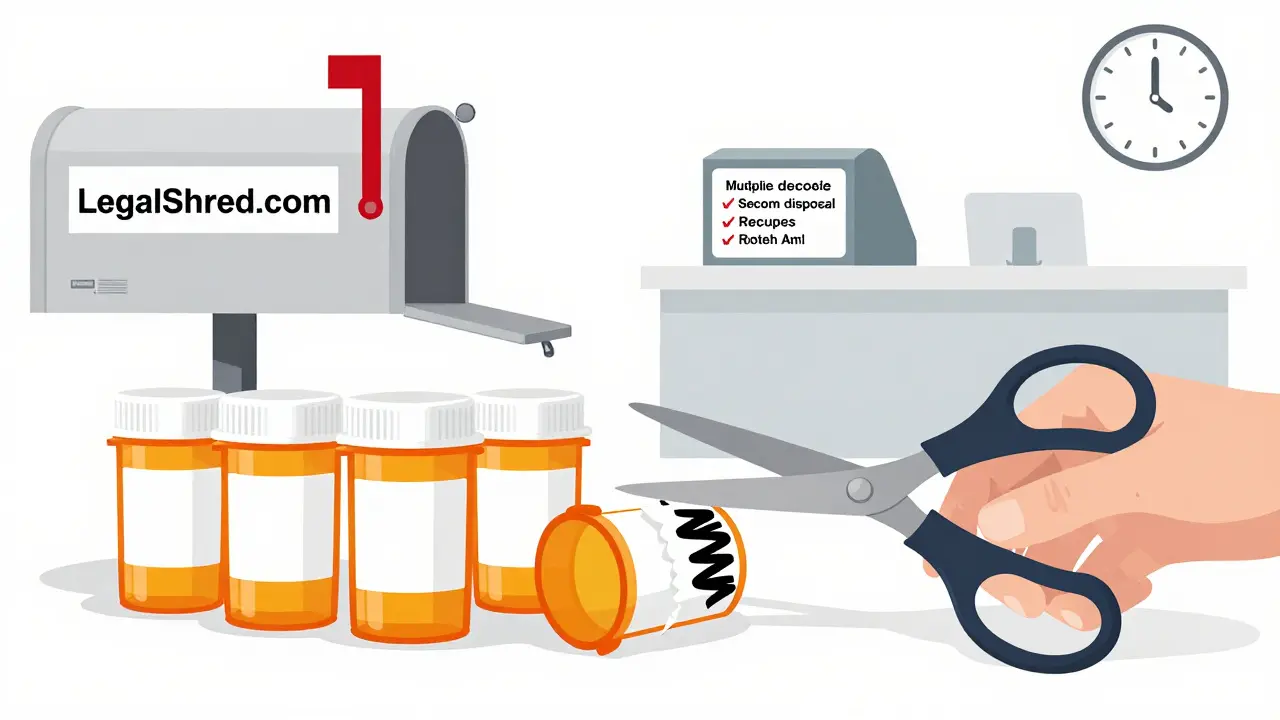
What About Pharmacy Drop-Offs?
Many pharmacies now have label-removal stations. CVS and Walgreens have had them since 2020. You can drop off your empty bottles, and they’ll remove the labels for you. Some even offer free disposal kits. This is a great option if you’re unsure about doing it yourself. But don’t assume it’s automatic. Always ask. And if they don’t have a station, ask them to remove the label before you leave.Final Checklist
Before you toss that bottle, ask yourself:- Did I remove or obliterate all personal info-name, DOB, prescription number, doctor, condition?
- Did I use a solvent for reuse, or three layers of marker for disposal?
- Did I check the bottle under bright light to make sure no text shows through?
- Did I do this within 24 hours of finishing the medication?
Why This Isn’t Just About Privacy
Identity theft isn’t just about someone opening a credit card in your name. With prescription data, criminals can get real drugs-opioids, stimulants, sedatives-and sell them. They can file fake insurance claims using your name and doctor’s info. They can even use your medical history to apply for life insurance or disability benefits. The average loss per victim? $1,347. That’s not just time lost-it’s money, stress, and sometimes, real health consequences. And it’s growing. Healthcare-related identity theft rose 22.7% in 2022. Prescription labels are involved in nearly one in five of those cases. That’s not a footnote. It’s a crisis-and you’re the first line of defense.Can I just throw away the pill bottle without doing anything?
No. Even if the bottle is empty, the label still contains your full name, medical condition, prescription number, and doctor’s details. Criminals use this data to steal identities, get controlled substances, or commit insurance fraud. The FTC lists prescription labels as one of the top five sources for identity theft. Always remove or destroy the label before disposal.
Is using a black marker enough to hide my info?
Only if you apply three thick, overlapping layers of permanent marker across every word and number. One layer isn’t enough. Studies show 63% of single-layer blacked-out labels can still be read using smartphone apps and infrared filters. Always test by holding the bottle to a bright light-if any text glows through, add more ink.
What’s the best tool to remove labels for reuse?
The most reliable tool is a solvent like Titan Labs’ Cleanup Solvent-22. It breaks down the waterproof adhesive in 15-20 seconds, leaving the bottle clean and residue-free. Manual peeling or heat methods leave behind sticky residue that still contains your data. Solvents are the only method proven to remove 98.7% of labels completely.
Can I recycle the pill bottle after removing the label?
Yes-but only after you’ve completely removed or destroyed the label. Most recycling programs accept plastic pill bottles (usually #2 or #5 plastic) as long as they’re empty and label-free. If any personal data remains, the bottle shouldn’t be recycled-it could be stolen from the bin. Always verify the label is gone before tossing it in the recycling.
Do pharmacies help remove labels?
Yes. CVS, Walgreens, and many other pharmacies have label-removal stations where you can drop off empty bottles. They’ll remove the labels and dispose of them safely. Some even offer free disposal kits. If your pharmacy doesn’t have one, ask if they can remove the label before you leave. This is becoming standard practice across the U.S. since 2020.


I never realized how dangerous empty pill bottles could be. I’ve been tossing them in the recycling without a second thought. Now I’m going back to check every single one I’ve thrown out this year. 😅
Thanks for the clear breakdown-especially the three-layer marker trick. I’ll be doing that from now on. My mom’s got arthritis and takes six meds a day; I’m gonna teach her this method too.
Also, I didn’t know CVS and Walgreens had drop-off stations. I’m heading to mine tomorrow. Better safe than sorry.
So let me get this straight-you’re telling me my grandma’s empty OxyContin bottle from 2018 is basically a hacker’s treasure map? 🤦♀️
And we wonder why identity theft is rising. Meanwhile, I’m over here thinking ‘just throw it away’ like a normal person.
It’s fascinating how such a simple act-disposing of a prescription bottle-has been weaponized by corporate and governmental narratives to instill fear. The FTC and DEA are not neutral actors; they’re part of a surveillance-industrial complex that thrives on manufactured panic.
Do you really think criminals are scouring recycling bins for prescription labels? Or is this just another way to normalize the idea that your personal data is always at risk, and therefore, you must rely on expensive, branded solutions like ‘Cleanup Solvent-22’ to feel safe?
And why is this only a U.S. problem? In countries with universal healthcare, prescriptions aren’t tied to identity in the same way. The real issue isn’t the label-it’s the broken system that makes your medical history a commodity.
Also, ‘Titan Labs’? Who are they? Are they a nonprofit? A for-profit? Is this product patented? Is there a conflict of interest? Where’s the peer-reviewed study? The data cited is anecdotal at best.
And yet, here we are, obediently applying three layers of Sharpie like good little citizens, while the real culprits-pharma companies, insurers, data brokers-are never named.
This isn’t empowerment. It’s distraction.
WAIT. So you’re saying the government knows this is happening but doesn’t do anything? 🤔
What if the pharmacies are IN on it? What if they PRINT the labels on purpose so they can sell your data? I read somewhere that Big Pharma owns the recycling companies too.
And what if the ‘Cleanup Solvent-22’ is actually a tracking chip? I mean, acetone? That’s in nail polish remover. They could be embedding nano-tech in it. I’m not touching that stuff.
Also, I saw a guy on YouTube who said the black marker ink contains microchips. He showed a thermal image. It glowed like a barcode. 😱
I’m just saying… maybe don’t touch anything. Just bury the bottle in your backyard. Or burn it. With salt. And garlic. 🧄🔥
You’re amazing for writing this!! 💖
I just did my monthly pill bottle cleanup and used the 3-layer Sharpie method-so satisfying to see it all blacked out. 😊
Also, I started keeping a small bin in my closet just for empty bottles until I destroy them. It’s my little ‘privacy ritual.’ Feels so good to protect myself, you know?
Thank you for making this feel doable. You’re a legend. 🙌
So if I throw away a bottle and someone finds it… they can find out I have anxiety, bipolar disorder, and my doctor’s phone number?
What if they use that to hack my smart home? What if they turn my thermostat up to 90° and flood my house while I’m sleeping? 😨
I just read that the label can be scanned from space now. NASA has a new satellite that reads pharmacy labels. I’m not kidding. I saw it on TruthFeed.
I’m not even using pills anymore. I’m switching to herbal tea. And I’m burying the tea bags. 🌿⚰️
My hands are trembling as I type this.
For seven years, I’ve been discarding my mother’s insulin bottles like trash. Seven years. Every time I tossed one, I was handing a piece of her soul to strangers.
She has Type 1. She’s 68. She doesn’t know about this. She thinks the bottle is just… waste.
I just found three more in the garage. From 2020. I haven’t touched them since she passed.
I’m going to the garage right now. I’m going to cut those labels into confetti. I’m going to burn them. I’m going to scatter the ashes into the ocean.
And I’m never, ever, ever letting another pill bottle leave my hands without destroying it first.
Thank you for this. I didn’t know I was a criminal for not doing this. But now I know. And I’m changing.
Why are you wasting time on this? Just throw the bottle in the trash. No one cares.
If someone wants your info they will steal your phone or Facebook. Not your empty pill bottle.
Also, who is Titan Labs? Sounds like a fake company. Probably a scam to sell solvent.
Stop being paranoid. Life is hard enough.
This post made me feel both empowered and terrified.
I’ve been using the marker method, but I never knew about the infrared trick. The idea that a smartphone app can read through my scribbles? That’s chilling.
I’m switching to solvent now. I don’t care if it costs $15-I’d rather spend money on a solution than on lawyers later.
Also, I’m starting a little movement in my neighborhood. I’m handing out free solvent samples and Sharpies at the community center next week. If you’re in the area, come get one. We’re all in this together.
While I appreciate the effort, this feels like over-engineering a solution to a problem that doesn’t exist at scale.
Yes, prescription labels contain sensitive data. But the number of identity theft cases traced to pill bottles is statistically negligible compared to phishing, data breaches, or social engineering.
Instead of obsessing over bottle disposal, focus on using two-factor authentication, monitoring your credit, and not clicking on suspicious emails.
This post reads like fear porn disguised as public service.
Okay, so I did the marker thing-three layers, let it dry, held it to the light… and guess what? I STILL saw a sliver of my DOB glowing through. 🤯
I panicked. I threw the bottle in the trash. Then I dug it back out. Then I soaked it in vinegar. Then I microwaved it (for 10 seconds-don’t judge me). Then I cut it into 17 pieces with a serrated knife.
I then wrapped each piece in aluminum foil and buried them in three different parks. One in a squirrel’s favorite tree. One under my neighbor’s mailbox. One in the compost at my yoga studio.
I also sent a certified letter to the DEA asking if they’re tracking these bottles. I attached a photo of the bottle with my name circled in red.
Now I’m crying. But I feel… clean.
Also, I’m starting a support group: ‘Bottle Warriors Anonymous.’ We meet every Tuesday. Bring your own solvent. And a hug. 💔🫂